

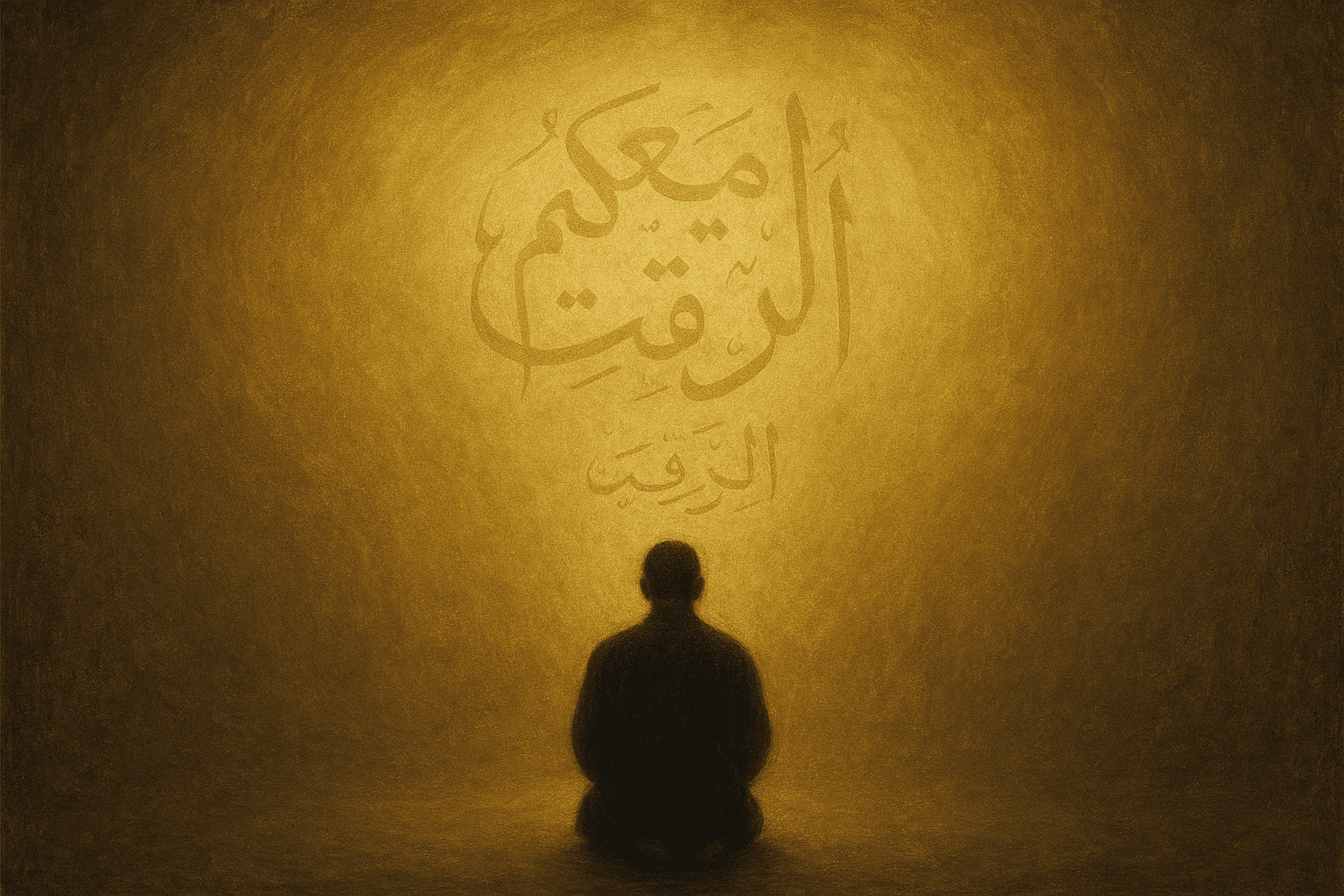
In an era defined by escalating psychosocial stress and spiritual yearning, contemplative practices from diverse traditions have emerged as vital resources for holistic well-being. This article provides a detailed comparative analysis of Muraqabah, an Islamic meditative practice centered on the vigilant awareness of Allah, and Mindfulness-Based Stress Reduction (MBSR), a secularized, therapeutic program derived from Buddhist meditation. Through an exploration of their theological/philosophical foundations, core methodologies, objectives, and outcomes, this paper argues that while both systems offer significant benefits for mental and emotional regulation, they are ultimately oriented toward divergent ultimate ends: MBSR toward enhanced present-moment awareness and stress reduction within a immanent frame, and Muraqabah toward the cultivation of God-consciousness (Taqwa) and the purification of the heart (Tazkiyat al-Nafs) within a transcendent, relational framework. The analysis highlights implications for integrative therapeutic approaches while respecting the integrity of each tradition.
1. Introduction: The Contemporary Landscape of Contemplation
The 21st century has witnessed a profound surge in the application of meditative and mindfulness practices within clinical, educational, and corporate settings. Pioneered by Kabat-Zinn (1990), Mindfulness-Based Stress Reduction (MBSR) has been extensively secularized and empirically validated, becoming a cornerstone of integrative mental health care. Concurrently, there has been a renewed interest among Muslim communities and scholars in reviving traditional Islamic contemplative disciplines, particularly Muraqabah, as a means of addressing modern psychological ailments while fulfilling spiritual obligations. This parallel rise invites a systematic comparison. Both practices train attention and awareness, yet they emerge from radically different worldviews. This article delves into the intricacies of Muraqabah and MBSR, examining their theoretical underpinnings, practical techniques, intended goals, and documented outcomes. The central thesis posits that superficial similarities in method obscure profound differences in foundational ontology and teleology, with significant implications for practitioners and clinicians.
2. Foundations and Worldview
2.1 Muraqabah: Rooted in Tawhid and the Unseen
Muraqabah (from the root *r-q-b*, denoting watchfulness, vigilance, and care) is not a standalone technique but an essential state of consciousness in Islamic spirituality (Sufism or Tasawwuf). Its foundation is the doctrine of Tawhid – the absolute Oneness and Sovereignty of Allah. Muraqabah is defined as the constant knowledge and awareness of the believer that Allah is “Watching Over” them in all states, internally and externally. This is derived from the Quranic verse: “And know that Allah knows what is within yourselves, so beware of Him” (Quran 2:235) and the famous Hadith Jibril, which defines Ihsan (spiritual excellence) as “to worship Allah as though you see Him, for if you do not see Him, He indeed sees you” (Sahih al-Bukhari).
The practice is inherently relational and theocentric. The cosmos is viewed as a meaningful creation (khalq) saturated with divine signs (ayat). The human self (nafs) is seen as a dynamic entity with inclinations toward both good and evil, requiring purification. The ultimate objective of Muraqabah is to cultivate Taqwa (God-consciousness), which then leads to the purification of the heart (qalb) from spiritual diseases (e.g., envy, pride, heedlessness) and its adornment with divine virtues (e.g., love, patience, gratitude). Authority stems from the Quran, Sunnah, and the transmitted teachings of recognized spiritual guides (shuyukh). Key classical texts elaborating on Muraqabah include Al-Ghazali’s Ihya Ulum al-Din and Ibn Qayyim al-Jawziyya’s Madarij al-Salikin.
2.2 Mindfulness-Based Stress Reduction (MBSR): A Secular Clinical Framework
MBSR, in contrast, is explicitly secular and operational. Developed by Kabat-Zinn (1990) at the University of Massachusetts Medical School, it extracts techniques—primarily from Theravada Buddhist Vipassana (insight) meditation—and strips them of their soteriological context. Its philosophical underpinnings are a blend of Buddhist psychology (the Four Noble Truths, the role of craving in suffering), systems theory, and contemporary cognitive science. The foundational worldview is largely immanent and phenomenological. Reality is approached through direct sensory experience; thoughts and emotions are observed as transient mental events within the field of consciousness, not as ultimate reflections of a metaphysical truth.
The model of self in MBSR is often described as “decentralized” or as a “stream of consciousness,” challenging the notion of a fixed, monolithic ego. Suffering (dukkha) is reinterpreted as stress, pain, and illness, exacerbated by automatic, judgmental thought patterns. The authority in MBSR is scientific empiricism and clinical efficacy. Its legitimacy is derived from randomized controlled trials (RCTs) and neuroimaging studies, not from sacred tradition. Key foundational texts are Kabat-Zinn’s (1990) Full Catastrophe Living and the subsequent clinical manuals developed by his colleagues.
3. Methodologies and Practice
3.1 The Technique of Muraqabah
The practice of Muraqabah typically follows a structured spiritual path (tariqah) under guidance. It often begins with:
- Physical Seclusion (Khalwah): Sitting in a quiet place, often following ritual purification (wudu).
- Posture: A dignified seated posture, sometimes in the prayer (salah) sitting position.
- Dhikr (Remembrance): The heart and tongue are engaged in the rhythmic repetition of a divine name or phrase (e.g., Allah, La ilaha illa Allah). This serves as the anchor for awareness.
- Visualization (Tasawwur): The practitioner may visually or conceptually place the Name or Presence of Allah in the center of their heart or before them.
- Witnessing (Mushahadah): The core activity is maintaining the internal feeling and conviction that “Allah is watching me now. He sees my heart, my thoughts, my state.” This is not a passive observation but an active, loving, and awe-filled vigilance.
- Introspection (Muhasabah): Following the session, one engages in self-accounting, reviewing thoughts and states that arose, seeking forgiveness for lapses, and gratitude for moments of presence.
Muraqabah is deeply integrated with other Islamic practices. It is considered the state of heart that should ideally accompany formal prayer (salah), fasting (sawm), and even daily activities. The practice moves through stages, from Muraqabat al-Ma’iyah (awareness of Allah’s general knowledge) to Muraqabat al-Qurb (awareness of Allah’s proximity) and ultimately Muraqabat al-Wujud (awareness that only Allah truly exists).
3.2 The Technique of MBSR
The standard 8-week MBSR program involves weekly group sessions and daily home practice. Core techniques include:
- Body Scan: A systematic, gradual movement of attention through the body from feet to head, observing sensations without judgment.
- Sitting Meditation: Attention is anchored to the breath, bodily sensations, sounds, or thoughts themselves, with the instruction to observe them as they arise and pass, always returning to the anchor.
- Hatha Yoga: Gentle mindful movement to cultivate body awareness.
- Informal Mindfulness: Bringing non-judgmental awareness to routine activities like eating, walking, or washing dishes.
The key operational instructions are “observe,” “note,” and “let go.” A central tenet is “non-elaborative awareness”—seeing thoughts as “just thoughts” rather than truths to be believed or acted upon. The therapist or instructor is a facilitator, not a spiritual guide in a traditional sense. The group setting is used for psychoeducation and shared inquiry into experience.
4. Objectives and Teleology: Divergent Ends of the Spectrum
Here lies the most critical distinction between the two systems.
4.1 The Goals of Muraqabah
The objectives of Muraqabah are hierarchical and ultimately transcendental:
- Immediate: To reduce heedlessness (ghaflah) and cultivate constant remembrance (dhikr) of Allah.
- Intermediate: To purify the heart (tazkiyat al-nafs) from blameworthy traits (akhlaq madhmumah) like anger, envy, and arrogance, and to embody praiseworthy traits (akhlaq mahmudah) like patience, contentment (rida), and love (mahabbah) for Allah.
- Ultimate: To attain Ihsan (excellence in worship) and the pleasure of Allah (mardat illah). The seeker aims for a transformative knowledge (ma’rifah) of Allah, leading to eternal salvation in the hereafter (akhirah). The reduction of psychological stress is a beneficial byproduct, but it is not the primary aim. In fact, some spiritual states (ahwal) encountered may involve temporary anguish or awe (haybah).
4.2 The Goals of MBSR
The goals of MBSR are immanent, psychological, and therapeutic:
- Immediate: To reduce symptoms of stress, anxiety, depression, and chronic pain by disrupting automatic reactive patterns.
- Intermediate: To develop a “decentered” perspective on one’s thoughts and emotions, fostering psychological flexibility, emotional regulation, and self-compassion.
- Ultimate: To enhance overall quality of life, well-being, and mindful engagement in the present moment. The frame is explicitly “stress reduction” and improved coping within one’s lifespan, without a soteriological or metaphysical endpoint.
As Shapiro et al. (2006) note, secular mindfulness aims for “re-perceiving” – a shift in perspective on one’s experience. In contrast, Lumbard (2015) argues that Muraqabah aims for “re-orienting” the entire self toward the Divine.
5. Outcomes and Efficacy: Empirical and Experiential
5.1 Documented Outcomes of MBSR
The empirical evidence for MBSR is vast and robust. Meta-analyses consistently show significant effect sizes for:
- Reduction in symptoms of anxiety and depression (Hofmann et al., 2010).
- Decreased perceived stress and improved stress coping.
- Management of chronic pain and improvement in quality of life for various medical conditions.
- Neuroplastic changes, including increased gray matter density in brain regions associated with learning, memory, and emotion regulation (e.g., hippocampus, prefrontal cortex) and decreased amygdala activity (Hölzel et al., 2011).
5.2 Documented and Traditional Outcomes of Muraqabah
Empirical, Western-style research on Muraqabah is nascent but growing. Studies often operationalize it as “Islamic meditation” or “dhikr-based therapy.” Findings suggest benefits similar to MBSR, including:
- Reduced anxiety and depression scores (Falah et al., 2021).
- Improved psychological well-being and quality of life.
- Enhanced spiritual well-being, a dimension often unmeasured in MBSR studies.
However, the primary “evidence” for Muraqabah within its own tradition is experiential and testimonial, recorded for centuries in Islamic literature. Reported outcomes include:
- Inward Tranquility (Sakina): A profound sense of peace descending from the divine presence.
- Illumination of the Heart (Tajalli): Clarity of insight and increased capacity for spiritual discernment.
- Annihilation (Fana) and Subsistence (Baqa): Advanced states where self-centeredness diminishes, and actions are experienced as being through Allah.
- Increase in Certainty (Yaqin): Unshakeable faith and trust in Allah.
Critically, Islamic psychology views negative mental states as having spiritual etiologies. Therefore, the remission of depression through Muraqabah is understood not merely as a neurological shift but as a consequence of the heart finding its true object of rest: “Verily, in the remembrance of Allah do hearts find rest” (Quran 13:28).
6. Critical Analysis and Potential Integration
6.1 Points of Convergence
Both practices:
- Train sustained, non-reactive attention.
- Encourage a shift from “doing” to “being” modes.
- Promote metacognition (awareness of thinking itself).
- Can reduce rumination and pathological self-focus.
- Share common physiological benefits (e.g., reduced cortisol, parasympathetic activation).
6.2 Points of Divergence
- Role of the Practitioner: In Muraqabah, the practitioner is a servant (abd) in a conscious, loving, and fearful relationship with a Personal God. In MBSR, the practitioner is an observer of their own phenomenological field.
- Treatment of Thoughts: MBSR teaches detachment from thoughts as mental events. Muraqabah encourages evaluating thoughts based on their divine origin (waswās from Satan, ilham from Allah), leading to discursive meditation (tafakkur) on divine creation or attributes.
- The Anchor of Attention: MBSR anchors in somatic/ sensory phenomena (breath, body). Muraqabah anchors in a metaphysical reality—the Name or Presence of Allah.
- Final Aim: MBSR seeks well-being in life. Muraqabah seeks a right relationship with the Creator of life, with well-being as a corollary.
6.3 Integrative Possibilities and Cautions
Integration must be approached with nuance. Keshavarzi & Haque (2013) advocate for the development of Islamic psychology frameworks that can dialogue with Western models while remaining rooted in tradition. For Muslim clients, MBSR techniques can be adapted by framing mindfulness as a contemporary form of muhasabah (self-accounting) or by using the breath as a reminder of the divine spirit (ruh). However, a wholesale, uncritical adoption of MBSR may risk reducing a rich spiritual discipline to a stress-management tool, a concern echoed by many Muslim scholars and some Western critics of secular mindfulness (Purser & Loy, 2013).
Conversely, clinicians in secular settings can benefit from understanding Muraqabah to provide culturally competent care to Muslim clients, recognizing that for them, ultimate healing is tied to faith.
Conclusion
The comparative analysis of Muraqabah and Mindfulness-Based Stress Reduction reveals a landscape of profound methodological similarity overshadowed by even more profound philosophical and teleological difference. MBSR, the product of a secular, therapeutic age, offers a powerful, evidence-based toolkit for navigating the pressures of immanent life. Muraqabah, rooted in the perennial Islamic worldview, offers a comprehensive spiritual pathway whose destination is the Divine Presence itself, with psychological benefits as harmonious side effects.
The choice between, or synthesis of, these practices is not merely technical but existential. It reflects one’s answer to fundamental questions: Is the ultimate goal to be at peace with the world, or to be at peace with the Lord of the worlds? Is human suffering primarily a psychological maladaptation or a symptom of spiritual disconnection? In an increasingly fragmented world, both traditions offer valuable insights. However, understanding their distinct contours is essential to honor their depth, avoid reductionism, and allow each to serve humanity in the fullness of its own design. For the secular seeker of peace, MBSR provides a proven path. For the believer seeking the Divine gaze, Muraqabah remains the vigilant, loving watchfulness that transforms not only the mind but the very soul.
SOURCES
Falah, A. K., Al-Refaei, A. A., & Al-Sabbagh, S. Z. (2021). The effect of Islamic meditation (Muraqabah) on anxiety and psychological well-being among university students during the COVID-19 pandemic: A randomized controlled trial. Journal of Muslim Mental Health, 15(2).
Al-Ghazali, A. H. (ca. 1100). Ihya ulum al-din [The revival of the religious sciences].
Hofmann, S. G., Sawyer, A. T., Witt, A. A., & Oh, D. (2010). The effect of mindfulness-based therapy on anxiety and depression: A meta-analytic review. Journal of Consulting and Clinical Psychology, 78(2), 169–183.
Hölzel, B. K., Carmody, J., Vangel, M., Congleton, C., Yerramsetti, S. M., Gard, T., & Lazar, S. W. (2011). Mindfulness practice leads to increases in regional brain gray matter density. Psychiatry Research: Neuroimaging, 191(1), 36–43.
Ibn Qayyim al-Jawziyya. (ca. 1300). Madarij al-salikin [The stations of the seekers].
Kabat-Zinn, J. (1990). Full catastrophe living: Using the wisdom of your body and mind to face stress, pain, and illness. Delacorte Press.
Keshavarzi, H., & Haque, A. (2013). Outlining a psychotherapy model for enhancing Muslim mental health within an Islamic context. International Journal for the Psychology of Religion, 23(3), 230–249.
Lumbard, J. (2015). The function of dhikrullah in Sufi psychology. In The psychology of spirituality (pp. 209-226). Routledge.
Purser, R. E., & Loy, D. R. (2013). Beyond McMindfulness. Huffington Post. Retrieved from [Note: While this is a popular source, it is a seminal critique often cited in academic literature. A suitable academic alternative is: Purser, R. (2019). McMindfulness: How mindfulness became the new capitalist spirituality. Repeater Books.].
Shapiro, S. L., Carlson, L. E., Astin, J. A., & Freedman, B. (2006). Mechanisms of mindfulness. Journal of Clinical Psychology, 62(3), 373–386.
HISTORY
Current Version
Jan 6, 2026
Written By
SUMMIYAH MAHMOOD




Leave a Reply