

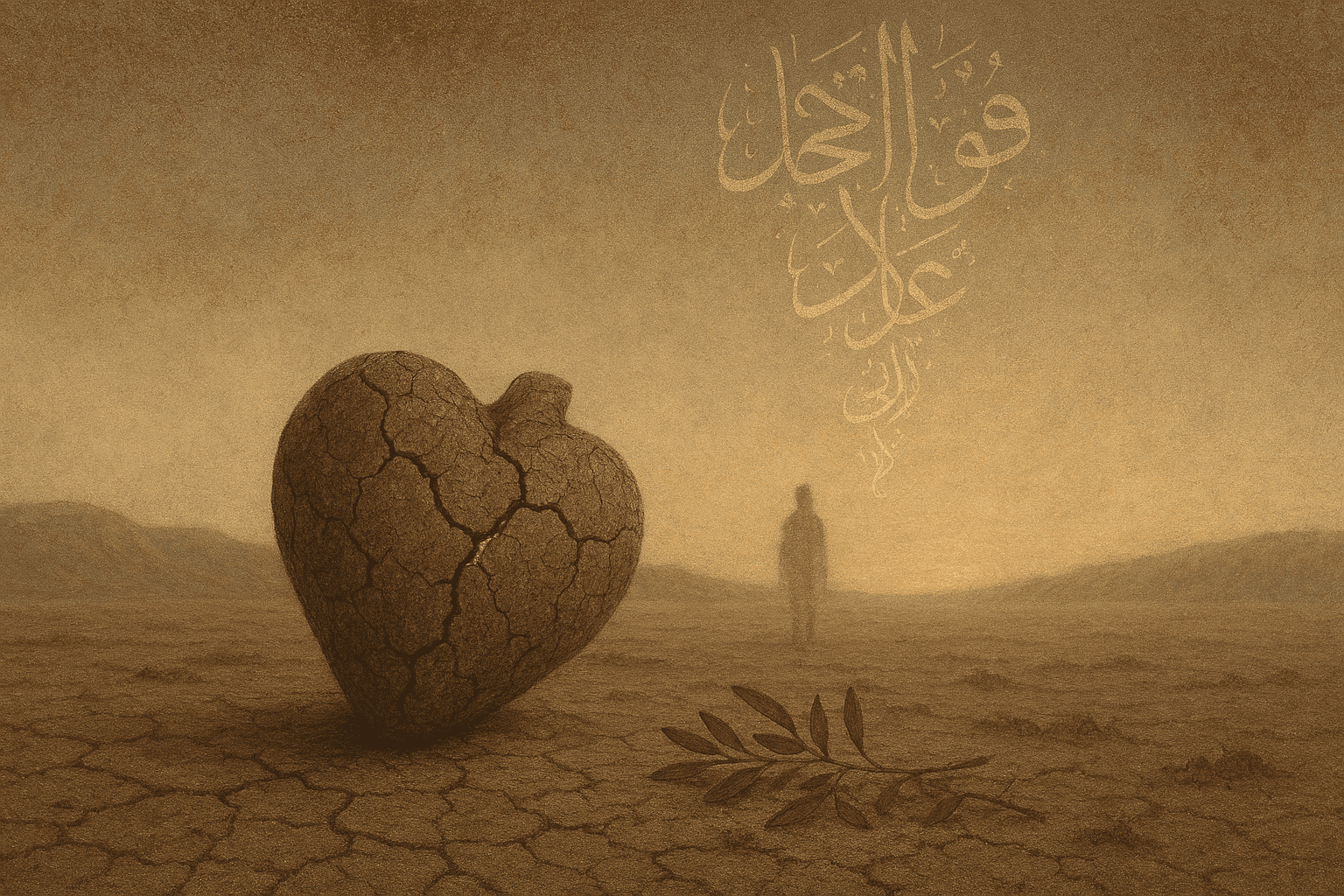
This article presents a detailed examination of the phenomenon of spiritual dryness, known in Islamic spirituality as Qaswat al-Qalb (hardening of the heart), from an integrative psychological perspective. It explores the theological and phenomenological foundations of the experience, characterized by emotional numbness, a sense of divine absence, and a decline in religious practice. The discussion synthesizes insights from Islamic tradition with contemporary psychological frameworks, including attachment theory, affective neuroscience, and trauma studies, to construct a multidimensional understanding of its etiology. The article argues that Qaswat al-Qalb is not merely a religious failing but a complex psycho-spiritual state with identifiable cognitive, emotional, and behavioral correlates. Subsequently, a comprehensive model for reconnection is proposed, integrating traditional spiritual practices—such as mindful remembrance (dhikr), scriptural engagement, and community service—with evidence-based psychological interventions like mindfulness, self-compassion, and cognitive restructuring. The conclusion posits that a holistic approach, honouring both the metaphysical and psychological dimensions, offers the most compassionate and effective path for navigating spiritual aridity and fostering sustainable reconnection.
Introduction: The Landscape of Spiritual Aridity
The human quest for meaning and connection with a transcendent reality is a near-universal constant. Yet, this journey is rarely linear or perpetually euphoric. Periods of profound disconnection, where once-vital spiritual practices feel empty and the sense of the divine seems distant or absent, are common across religious traditions. In Christianity, this is termed the “dark night of the soul” (St. John of the Cross); in Buddhist psychology, it may align with certain states of dukkha (suffering) and disenchantment. Within the Islamic spiritual canon, this experience is meticulously described as Qaswat al-Qalb—the hardening, desiccation, or rusting of the heart.
The “heart” (qalb) in Islamic anthropology is not merely the physical organ nor solely the seat of emotions as often construed in the West. It is the comprehensive locus of intellect, intention, faith, and spiritual perception. Al-Ghazali (c. 1058–1111), in his monumental Ihya’ ‘Ulum al-Din (The Revival of the Religious Sciences), delineates the heart as the faculty through which one knows God, and its health determines one’s entire existential orientation. Thus, Qaswat al-Qalb represents a critical impairment of this core faculty. It manifests as a loss of sensitivity to spiritual stimuli, a dryness in prayer, a numbness to ethical impulses, and a feeling of being separated from the Divine presence.
This article aims to move beyond a purely theological discourse and examine Qaswat al-Qalb through the lens of modern psychology. It posits that spiritual dryness is a psychospiritual interface phenomenon, where psychological states can influence spiritual perception and vice-versa. By integrating traditional wisdom with contemporary science, we can develop a more nuanced, compassionate, and effective framework for understanding this painful state and mapping a journey back to reconnection.
Part 1: Deconstructing Qaswat al-Qalb – Definitions, Symptoms, and Etiology
1.1 Theological and Phenomenological Foundations
The Quran frequently addresses the condition of the heart, warning of its potential to become hardened: “Then, your hearts became hardened after that, being like stones or even harder…” (Quran 2:74). The metaphors are visceral: rust (ran) covering the heart (Quran 83:14), locking, sealing, and disease. Classical scholars like Ibn Qayyim al-Jawziyya (1292–1350) elaborated on the progressive nature of this hardening, often beginning with negligence (ghaflah), leading to sin, which, if persistent, forms a rust that can eventually seal the heart.
Phenomenologically, individuals experiencing Qaswat al-Qalb report a constellation of symptoms:
- Affective Dryness: Prayers, recitation, and once-meaningful rituals feel robotic, empty of feeling or devotion (khushu’).
- Cognitive Dissonance: Intellectual belief may remain, but it is divorced from lived experience, creating a split between “knowing” and “feeling.”
- Volitional Paralysis: A significant decrease in motivation for worship, ethical action, and community engagement, often accompanied by procrastination.
- Emotional Numbness/Avoidance: Not only a lack of spiritual feeling but often a broader affective blunting or a tendency to avoid emotional and spiritual introspection due to associated pain.
- Existential Doubt and Alienation: Questions about the purpose of worship, the reality of the Divine connection, and a feeling of isolation from both God and the faith community.
Crucially, this is distinct from clinical depression, though they can co-exist. Depression typically involves a pervasive anhedonia across all life domains and negative affect, whereas spiritual dryness is often specifically oriented toward the spiritual dimension, even if it radiates outward. However, the comorbidity requires careful discernment, a point where psychological and spiritual guidance must converge.
1.2 Psychological Frameworks: A Synthetic Etiological Model
Understanding Qaswat al-Qalb psychologically requires moving beyond a sin-based model to a multifactorial one. Several psychological frameworks illuminate its potential roots:
- Attachment Theory (Bowlby, Ainsworth): God is often conceptualized as an attachment figure—a source of security, safe haven, and secure base. Granqvist, Mikulincer, & Shaver (2010) have extensively researched religion through this lens. Qaswat al-Qalb can be viewed as an expression of an “insecure attachment” to the Divine, often triggered by perceived divine absence or unanswered prayers. For individuals with underlying insecure attachment styles, life stressors (loss, trauma, failure) can activate fears of abandonment, leading to a deactivating strategy—emotional withdrawal and compulsive self-reliance—that manifests as spiritual dryness. The heart “hardens” as a protective mechanism against the pain of perceived divine rejection or indifference.
- Affective Neuroscience and Apathy: Neurological research on apathy—a disorder of motivation characterized by reduced goal-directed behavior, cognition, and emotion—offers intriguing parallels. The neural circuits involved, including the anterior cingulate cortex and prefrontal-striatal pathways, are crucial for valuation, effort computation, and emotional engagement. Chronic stress, burnout, or depression can dysregulate these systems, leading to a state of pervasive disengagement. Spiritual practice requires cognitive and emotional effort; when these neural systems are depleted, spiritual apathy or dryness can be a direct consequence. This frames dryness not as a moral failure but, at times, as a neuro-affective state requiring rest and restoration.
- Cognitive-Behavioral Factors: Cognitive models highlight the role of maladaptive schemas and automatic thoughts. Watts (2007) discusses how religious cognitions can contribute to distress. In Qaswat al-Qalb, cognitive distortions may include: “catastrophizing” the dry period as a permanent state of damnation, “all-or-nothing thinking” about one’s spiritual worth, and “emotional reasoning” (“I feel nothing, therefore God is not there”). These thoughts fuel a vicious cycle: dryness leads to negative cognitions, which produce guilt and anxiety, which further inhibit the positive emotions associated with practice, deepening the dryness.
- Trauma and Disintegration: Psychological trauma, whether acute or complex, can shatter core assumptions about the world being safe, meaningful, and oneself being worthy. For a religious individual, trauma can violently disrupt one’s relationship with the Divine (“Where was God?”). The psyche, in an effort to survive, may wall off not only the traumatic memory but also the associated spiritual longings and vulnerabilities, leading to a generalized spiritual numbness—a qaswah as a trauma response. The work of Herman (1992) on trauma and recovery is essential here, emphasizing the need for safety and reconstruction of meaning.
- Existential and Meaning-Making Crises: Frankl’s logotherapy posits that the primary motivational force is the will to meaning. Periods of spiritual dryness often coincide with existential transitions, profound loss, or challenges to one’s worldview. When the previous narrative that gave life meaning no longer holds, and a new one has not yet formed, a “psychospiritual vacuum” ensues. This vacuum is the fertile ground for Qaswat al-Qalb, as old rituals lose their meaning before new understanding emerges.
Part 2: The Pathways to Reconnection: An Integrative Approach
Reconnection requires a dual-path strategy: addressing the psychological barriers and gently re-engaging the spiritual faculties. The goal is not to force feeling, but to create the conditions—internal and external—where the heart can naturally soften again.
2.1 Psychological Foundations for Spiritual Re-engagement
- Cultivating Self-Compassion (Neff, 2003): Counteracting the shame and self-recrimination that often accompany dryness is paramount. Neff (2003) defines self-compassion as kindness toward oneself, recognition of common humanity, and mindful awareness. Applying this to spiritual dryness means meeting one’s experience with kindness rather than judgment, understanding that such periods are a nearly universal part of the spiritual journey, and holding one’s feelings in balanced awareness. This creates a safe inner environment, reducing the threat response that perpetuates hardness.
- Mindfulness and Decentering: Mindfulness practice trains individuals to observe thoughts and feelings without immediate identification or reaction. This helps “decenter” from the catastrophic thoughts about dryness (“I am lost forever”). One learns to see the thought “God has abandoned me” as just a thought, not an absolute truth. This breaks the cognitive fusion that fuels the cycle of distress, creating space for new perspectives.
- Cognitive Restructuring: Actively challenging the distortions mentioned earlier. This involves evidence-based questioning: “Is this feeling of absence truly evidence of God’s absence, or could it be a perception filtered through my current state of stress/grief?” “Have I had periods of connection before? What might that suggest?” The aim is to develop a more balanced, less alarming narrative about the dry period.
- Addressing Underlying Issues: If the dryness is linked to burnout, therapy for depression, or processing trauma, these must be addressed through professional psychological care. Engaging in spiritual practice while ignoring a clinical condition can be ineffective and harmful. Spiritual direction and psychotherapy are complementary, not contradictory.
2.2 Traditional Spiritual Practices Revisited through a Psychological Lens
Traditional Islamic remedies for Qaswat al-Qalb are profoundly psychologically astute when viewed through this integrated model.
- Dhikr (Mindful Remembrance) as Attentional Training: Dhikr, the repetitive invocation of God’s names, is often prescribed as the primary cure for the heart’s rust. Psychologically, this can be understood as a form of focused attention meditation. It trains the “muscle” of concentration, pulling the mind away from ruminative loops of worry and guilt. Each time the mind wanders to “I am not feeling this,” and is gently returned to the phrase, it is an exercise in cognitive flexibility and attentional control, directly countering the rigid, self-focused state of dryness.
- Contemplative Engagement with Scripture (Tadabbur): Moving from rote recitation to deep, reflective contemplation engages the cognitive and emotional faculties simultaneously. Encouraging individuals to sit with a short verse, reflecting on its meanings and personal implications, stimulates meaning-making and intellectual engagement, which can re-open pathways to emotional resonance.
- Service to Others (Khidmah) as Behavioral Activation and Self-Transcendence: Acts of charity and service (sadaqah) and kindness are strongly emphasized. Behaviorally, this acts as a form of “behavioral activation”—a proven intervention for depression. Engaging in valued action, regardless of current mood, can shift affect over time. Moreover, service facilitates self-transcendence, shifting focus from the inner void to the needs of others, which can paradoxically re-sensitize the heart.
- Spiritual Companionship (Suhbah): Isolation exacerbates dryness. The Prophetic tradition emphasizes the importance of righteous company. A supportive spiritual companion, director, or community provides corrective emotional experiences, normalizes the struggle, and offers external encouragement for practice when internal motivation is low. This mirrors the therapeutic alliance and social support mechanisms crucial for psychological well-being.
- Gratitude (Shukr) as a Positive Neuroplasticity Intervention: The Quran relentlessly commands gratitude. The practice of daily gratitude journaling is a well-established positive psychology intervention. It systematically shifts attention from deficits to provisions, training the brain to scan for goodness. This counteracts the negativity bias that dominates during Qaswat al-Qalb and can gradually reshape affective patterns.
- Embodied Practices: Ablution (Wudu) and Prayer (Salah) as Somatic Regulation: The Islamic ritual prayer is a full-sensory, embodied practice. The rhythmic movements, combined with focused recitation, can serve as a powerful somatic regulation technique. For someone trapped in cognitive rumination or emotional numbness, the physicality of salah can provide a “bottom-up” pathway to calm and presence, bypassing the hyperactive or shut-down thinking brain.
Conclusion
Qaswat al-Qalb is a profound human experience that sits at the crossroads of the spiritual and the psychological. To dismiss it as mere religious negligence is to ignore its complex etiology and the very real suffering it entails. Conversely, to reduce it solely to a psychological syndrome is to strip it of its meaningful spiritual context and its potential as a transformative passage.
An integrative model, as proposed here, allows for a compassionate, multidimensional response. It recognizes that the heart can be hardened by sin, but also by trauma, by insecure internal working models, by cognitive distortions, by neurological dysregulation, and by existential crisis. Therefore, the healing must be equally multifaceted.
The journey of reconnection is not a swift return to a previous emotional high. It is often a slow, patient cultivation of the conditions where the heart can soften—a process built on psychological self-care, compassionate self-inquiry, and the disciplined, gentle return to traditional practices whose wisdom is now illuminated by science. It is in the synergy of these paths—where mindfulness deepens dhikr, where self-compassion softens the approach to prayer, where therapeutic insight clears the blocks to surrender—that the rust is gently polished away. In this integrative space, the arid heart is not condemned but understood, and in that understanding, finds the first drops of the rain for which it yearns.
SOURCES
Al-Ghazali. (2004). The remembrance of death and the afterlife: Book XL of the Revival of the religious sciences (T. J. Winter, Trans.). The Islamic Texts Society. (Original work published c. 1100)
Frankl, V. E. (1985). Man’s search for meaning. Washington Square Press. (Original work published 1946)
Granqvist, P., Mikulincer, M., & Shaver, P. R. (2010). Religion as attachment: Normative processes and individual differences. Personality and Social Psychology Review, 14(1), 49–59.
Herman, J. L. (1992). Trauma and recovery: The aftermath of violence–from domestic abuse to political terror. Basic Books.
Ibn Qayyim al-Jawziyya. (2010). The disease and the cure (J. Abualrub, Trans.). Al-Madinah Publishers.
Neff, K. D. (2003). The development and validation of a scale to measure self-compassion. Self and Identity, 2(3), 223–250.
Watts, F. (2007). Emotion regulation and religion. In J. J. Gross (Ed.), Handbook of emotion regulation (pp. 504–520). The Guilford Press.
Note on Quranic References: Verses from the Quran are cited by chapter and verse number. Standard translations were consulted (e.g., Sahih International).
HISTORY
Current Version
Jan 7, 2026
Written By
SUMMIYAH MAHMOOD




Leave a Reply