

Introduction: Sound as a Pathway to the Soul
The Qur’an was not revealed merely as a silent text to be read privately, or only as a legal code to be implemented through external compliance. It was revealed as recitation—a living, sounded, rhythmic event that addresses the human being in totality: heart, intellect, body, and nervous system. From its earliest moments of revelation, the Qur’an entered human consciousness through vibration, cadence, pause, and breath, shaping experience before it shaped doctrine. The auditory form of the Qur’an is therefore not an aesthetic addition or cultural embellishment; it is integral to its transformative and healing power.
The Qur’an command “Recite” (ire) establishes sound as the primary medium of divine encounter. Revelation unfolded orally, received through listening, memorization, and embodied repetition. This oral transmission engaged not only cognition but somatic awareness, synchronizing breath with verse, attention with rhythm, and emotion with meaning. Classical scholars recognized that the heart responds to sound before it fully processes concepts, which is why recitation often softens grief, steadies anxiety, and restores inward balance even before intellectual comprehension is complete.
Modern psychology and neuroscience have begun to affirm what the Qur’an tradition articulated centuries ago: rhythm, patterned language, and vocal resonance regulate emotional states and physiological coherence. Repetitive, measured sound has been shown to calm the autonomic nervous system, stabilize heart rate variability, and reduce stress-related hyper arousal. Qur’an recitation naturally incorporates these elements—structured pauses, melodic intonation, and controlled breathing—creating an embodied state of calm attentiveness rather than dissociation or suppression.
Within this framework, tilāwah is not merely an act of worship confined to ritual obligation; it functions as a rhythmic therapy for the soul. It gathers the fragmented self, reorders scattered attention, and aligns inner turbulence with divine cadence. The recite does not escape reality; rather, reality is re-entered with greater coherence, patience, and trust. In this sense, Qur’an recitation does not promise a life without strain—it offers a way to carry strain without inner disintegration, restoring harmony between the human interior and the divine order that sustains it.
1. Qur’an as Recitation, Not Mere Text
The very name Qur’an derives from maraca—to recite, to gather, to bring together. This linguistic root signals that the Qur’an is meant to be experienced as an unfolding auditory event. Written mushers preserve the revelation, but recitation activates it.
In Islamic tradition, recitation is inseparable from meaning. The pauses (waif), elongations (mad), and tonal modulations (maqāmāt) are not aesthetic additions; they are carriers of psychological and spiritual impact. Through recitation, meaning enters not only cognition but sensation.
Neuroscientifically, spoken language engages bilateral brain networks more fully than silent reading. Rhythm and melody activate limbic structures associated with emotion, safety, and attachment. The Qur’an, when recited, therefore bypasses purely analytical defenses and speaks directly to the affective core of the human being.
2. Rhythm and Regulation of the Nervous System
One of the most profound effects of Qur’an recitation lies in its capacity to regulate the nervous system. Human stress is largely mediated through autonomic imbalance—sympathetic over activation (fight-or-flight) and parasympathetic under-engagement (rest-and-digest).
Qur’an recitation naturally slows breathing, especially when recited with tartly—measured, deliberate pacing as commanded in the Qur’an itself. Slow, rhythmic breathing stimulates the vague nerve, reducing cortical levels and calming physiological arousal.
Repetitive verses, recurring sounds, and predictable cadences create a sense of safety. This predictability is crucial for trauma-affected nervous systems, which remain hyper vigilant to uncertainty. The Qur’an’s rhythmic structure reassures the body before it convinces the mind.
3. The Healing Power of Repetition
Repetition in the Qur’an is often misunderstood as redundancy. In reality, it functions as psychological reinforcement and emotional containment. Repeated phrases such as “Which of the favors of your Lord will you deny?” or “So be patient with beautiful patience” act as stabilizing anchors.
Psychologically, repetition soothes the anxious mind by reducing cognitive load. It allows meaning to descend gradually rather than overwhelm. Spiritually, repetition engrains remembrance (shirk) into the heart, transforming awareness into disposition.
This mirrors therapeutic techniques where affirmations or mantras are used to restructure internal narratives. Qur’an repetition, however, does not center the ego—it reenters the soul around divine reality.
4. Sound, Vibration, and Embodied Meaning
Sound is vibration, and vibration affects the body at a cellular level. Classical scholars noted that Qur’an recitation moves the heart (taḥrīk al-alb), not metaphorically but experientially.
Modern studies on sound therapy suggest that low-frequency; steady rhythms reduce muscle tension and emotional agitation. The Qur’an’s phonetic balance—alternating between soft letters (surf layyinah) and emphatic sounds (surf mufakhkhamah)—creates a dynamic equilibrium between firmness and gentleness.
This balance mirrors the Qur’an worldview itself: mercy and justice, hope and fear, awe and intimacy. The body receives these meanings somatically before they are articulated intellectually.
5. Qur’an Recitation and Emotional Processing
The Qur’an does not avoid emotional depth. It speaks of grief, fear, longing, remorse, hope, and relief. When recited, these themes allow suppressed emotions to surface safely within a sacred container.
Many believers report crying during recitation without fully understanding why. This is not emotional instability; it is emotional release. The Qur’an provides language for feelings the soul could not previously articulate.
From a psychological lens, this is catharsis guided by meaning. Unlike uncontrolled emotional discharge, Qur’an recitation channels emotion toward surrender, repentance, or trust—preventing overwhelm while allowing authenticity.
6. Trauma, Memory, and the Qur’an
Trauma fragments memory and disrupts narrative coherence. Survivors often feel trapped in intrusive sensations without meaning. Qur’an recitation offers an alternative narrative—one in which suffering is contextualized within divine wisdom.
Auditory memory is among the most resilient forms of memory. Even individuals with cognitive decline often retain memorized recitations. This makes the Qur’an a lifelong companion, accessible even when other faculties weaken.
For trauma survivors, familiar recitations can restore a sense of continuity and identity, grounding the self in something stable and transcendent.
7. The Role of Tajwīd in Healing
Tajwīd is often treated as technical precision, but its deeper function is ethical and psychological. It teaches restraint, patience, attentiveness, and respect for boundaries.
Elongating where elongation is due and stopping where stopping is required trains the recite to slow down—counteracting the haste that characterizes anxious states. Tajwīd disciplines the breath, and the breath disciplines the mind.
In this way, correct recitation is not perfectionism; it is regulation through reverence.
8. Communal Recitation and Collective Regulation
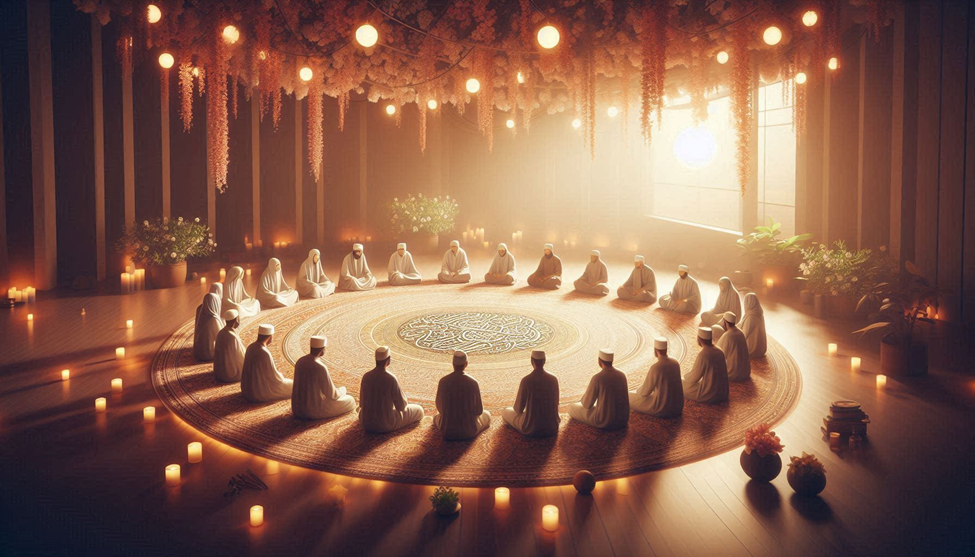
When the Qur’an is recited collectively—such as in tarāwīḥ or gatherings of shirk—it synchronizes emotional states across individuals. Collective rhythm fosters belonging and reduces isolation.
Psychologically, shared auditory experiences strengthen social bonds. Spiritually, they reinforce the sense of being part of an amah that remembers Allah together.
This collective regulation is especially healing in times of communal trauma, grief, or uncertainty.
9. Listening Versus Reciting: Distinct Benefits
Listening to Qur’an recitation allows passive absorption, beneficial during exhaustion or emotional depletion. Reciting actively engages agency, beneficial for empowerment and focus.
Both modes have therapeutic value. Listening soothes; reciting stabilizes. Together, they form a complete healing rhythm.
10. The Qur’an as Ongoing Emotional Maintenance
Qur’an recitation is not an emergency intervention alone; it is preventative care for the soul. Regular engagement maintains emotional elasticity, preventing buildup of unresolved strain.
Just as physical hygiene prevents illness, spiritual rhythm prevents burnout. The Qur’an recalibrates perspective daily, reminding the heart of its ultimate anchor.
Conclusion
The healing rhythm of Qur’an recitation lies not only in its melodious sound but in a holistic interplay of sound, meaning, breath, and surrender that engages the human psyche on multiple levels. Beyond promising an absence of stress, Qur’an recitation offers a way to carry stress without fragmentation—by inviting the listener into a measured pace of concentration, remembrance (shirk), and spiritual anchorage. In clinical and psychological research, listening to or reciting the Qur’an has been shown to reduce anxiety, stress, and even depression through non-pharmacological processes that modulate physiological stress responses such as heart rate and cortical levels.
Psychological studies highlight how the rhythmic intonation of Qur’an verses fosters relaxation akin to sound therapy by influencing brainwave patterns, increasing alpha rhythms associated with calm and attention. This rhythmic pattern also dovetails with breath regulation: intentional, measured recitation inherently slows respiration and fosters a sense of inner stability. Beyond physiological effects, the content of Qur’an verses—rich with themes of divine mercy, patience, and surrender—offers cognitive and emotional reframing that strengthens resilience and meaning-making in stressful contexts.
From a spiritual perspective, Qur’an recitation functions as an embodied act of remembrance that realigns the scattered self, reminding the believer of divine accompaniment amid life’s noise. The listener or recite enters a contemplative space where sound becomes remembrance and surrender, bridging the inner world of emotion with transcendent meaning. Research rooted in both psychological and phenomenological methods confirms the Qur’an’s impact on mental well-being, heart-brain coherence, and emotional regulation across diverse contexts.
In essence, Qur’an recitation does not erase life’s challenges—it reorients the soul, offering a rhythm by which stress can be carried with coherence, presence, and profound spiritual resonance.
SOURCES
Al-Ghazzālī — Iḥyāʾ Culm al-Den (c. 1095) – Classical work on spiritual psychology explaining how Qur’an recitation purifies the heart, disciplines attention, and restores inner equilibrium.
Al-Babar — Tafsīr al-Babar (c. 923) – Early Qur’an exegesis emphasizing meaning, contemplation, and how divine speech shapes cognition and moral consciousness.
Al-Qurṭubī — Al-Jami li-Aḥkām al-Qurʾān (c. 1273) – Integrates legal, spiritual, and emotional dimensions of Qur’an engagement, highlighting recitation as ethical formation.
Bin al-Qayyim — Zed al-Maʿād (1349) – Discusses Qur’an as spiritual medicine, linking recitation with emotional regulation and resilience.
Eyed Hussein Nasr — The Heart of Islam (2002) – Explores the Qur’an as a living presence that harmonizes intellect, soul, and embodied practice.
William A. Graham — Beyond the Written Word (1987) – Foundational study on Qur’an as recited revelation, emphasizing sound, memory, and lived experience.
Kristina Nelson — the Art of Reciting the Qur’an (2001) – Detailed ethno musicological analysis of Qur’an rhythm, melody, and their emotional effects.
Charles Hirsch kind — The Ethical Sounds cape (2006) – Examines how Qur’an listening reshapes moral sensibilities and emotional discipline through sound.
Harold G. Koenig — Handbook of Religion and Health (2012) – Comprehensive review of how religious practices, including recitation, influence mental health.
Herbert Benson — The Relaxation Response (1975) – explains physiological calming mechanisms activated by rhythmic, focused verbal practices.
Stephen Purges — The Polyvagal Theory (2011) – shows how vocal rhythm and breath regulate the nervous system and promote emotional safety.
Andrew Newberg & Eugene d’Aquili — why God Won’t Go Away (2001) – Neuroscientific exploration of how sacred recitation alters brain states and perception of meaning.
Judith Becker — Deep Listeners (2004) – Investigates how sustained listening practices produce trance, calm, and emotional integration.
Daniel J. Levi tin — This Is Your Brain on Music (2006) – Provides neuroscientific insight into rhythm, repetition, and emotional regulation via sound.
Antonio Dalasi — Self Comes to Mind (2010) – explains how bodily rhythms and meaning shape coherent self-experience.
Othman Hechehouche et al. — Qur’an Sound and Psychological Healing (2020) – Empirical study demonstrating stress reduction through Qur’an sound patterns.
Nor Fating Rally et al. — Qur’an Recitation and Physiological Stress (2025) – Shows measurable decreases in heart rate and anxiety during Qur’an listening.
Ramah T. N. et al. — Brainwave Effects of Qur’an Listening (2025) – EEG-based research linking Qur’an rhythm to alpha brainwave activation.
Babamohamadi et al. — Qur’an Recitation and Anxiety Reduction (2015) – Clinical evidence of reduced anxiety in patients exposed to recitation.
El-Had & Kneel — Physiological Responses to Qur’an Recitation (2017) – Documents autonomic nervous system stabilization during recitation.
Hannifin et al. — Qur’an Recitation as Stress Therapy (2023) – Reviews Qur’an as a non-pharmacological stress intervention.
Hachure et al. — Psychological Impact of the Noble Qur’an (2025) – Integrates Islamic psychology with modern mental-health frameworks.
HISTORY
Current Version
Dec 26, 2025
Written By
ASIFA





Leave a Reply