

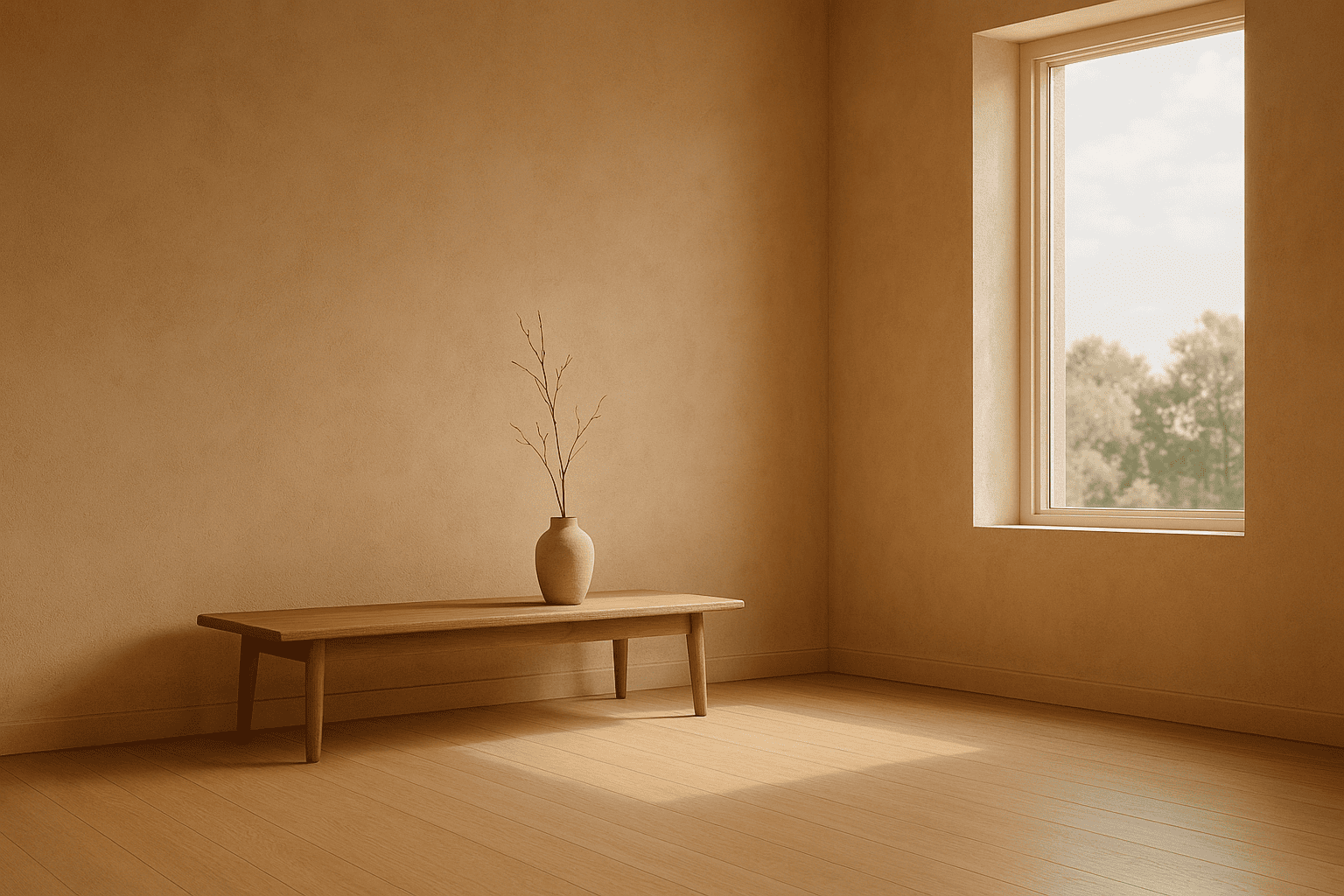
In an era characterized by digital saturation, consumerist abundance, and constant environmental stimulation, the human psyche is facing an unprecedented crisis of overload. This article posits that the application of Minimalism, deeply rooted in the spiritual and philosophical concept of Zuhd (asceticism or mindful detachment), to home design offers a potent, practical antidote to sensory and mental exhaustion. Moving beyond a mere aesthetic trend, we explore Minimalist Zuhd as a holistic design philosophy that intentionally curates the domestic environment to foster tranquility, focus, and spiritual well-being. Through a detailed examination of its principles—intentionality, emptiness, naturality, and mono-functionality—this article outlines a framework for creating homes that serve not as warehouses of possessions but as sanctuaries for restoration. We analyze the psychological and neuroscientific benefits of such environments, including reduced cognitive load, decreased anxiety, and enhanced clarity. Finally, a practical guide for implementation is provided, advocating for a mindful, iterative process of reduction and refinement.
Introduction: The Overloaded Habitat
The 21st-century home is paradoxically both a refuge and a source of stress. It is a repository for the material gains of our lives, filled with furniture, gadgets, decor, and the incessant background hum of digital devices. Visually, it is often a cacophony of colors, patterns, and textures. This constant, low-grade bombardment contributes significantly to what psychologists term sensory overload—a state where the senses are inundated with more stimuli than the brain can comfortably process—and its cognitive counterpart, mental clutter, characterized by fragmented attention and persistent background anxiety (Hodgkinson, 2021; Williams, 2018).
Enter Minimalism as a design movement. Often associated with sparse, white-walled interiors, it is sometimes dismissed as cold, sterile, or elitist. However, when viewed through the lens of Zuhd, a concept with profound roots in Islamic spirituality and Stoic philosophy, Minimalism transcends aesthetics to become a philosophy of life and space. Zuhd, derived from the Arabic root meaning to renounce or practice austerity, is not about poverty or deprivation. Rather, it is the mindful detachment from worldly excess to focus on what is of true value—a voluntary simplicity that liberates the heart and mind (Al-Ghazali, circa 1100/2014). When applied to home design, Minimalist Zuhd is the intentional creation of an environment that strips away the non-essential to reduce sensory input, thereby creating physical and mental space for peace, reflection, and meaningful engagement.
This article argues that adopting Minimalist Zuhd in home design is a critical intervention for mental health in the modern world. By systematically reducing visual noise, physical clutter, and multi-sensory distractions, we can craft domestic landscapes that actively lower cortisol levels, conserve cognitive resources, and facilitate a state of calm awareness.
1. Theoretical Foundations – Minimalism Meets Zuhd
1.1 The Philosophy of Zuhd: Detachment as Liberation
The concept of Zuhd has been central to Islamic ethical thought for centuries. The scholar Al-Ghazali, in his seminal work The Revival of the Religious Sciences, dedicated a volume to Zuhd, defining it not as the mere absence of possessions but as a state of the heart that does not grieve over what is lost nor rejoice excessively in what is gained (Al-Ghazali, circa 1100/2014). It is a tool for achieving tuma’ninah (tranquility). In a similar vein, Stoic philosophers like Seneca and Marcus Aurelius advocated for a life free from the slavery to unnecessary desires and external goods. This philosophical bedrock provides Minimalism with a “why” that is deeper than visual appeal: it is about freedom. In the home, Zuhd translates to freedom from the burden of cleaning, organizing, insuring, and worrying about excessive possessions; freedom from the tyranny of trends; and freedom for the mind to rest.
1.2 Modern Minimalism: From Aesthetic to Ethos
Modern architectural and design minimalism, pioneered by figures like Ludwig Mies van der Rohe (“less is more”) and Dieter Rams (“less, but better”), began as a reaction to ornamentation and clutter. It emphasized function, clean lines, and the essence of form. In recent decades, figures like Marie Kondo (2014) and The Minimalists (Joshua Fields Millburn & Ryan Nicodemus, 2011) have popularized the practice of decluttering, linking the state of one’s home directly to the state of one’s mind. Greg McKeown (2014), in Essentialism, framed it as a disciplined pursuit of less but better in all life choices. Neuroscience now supports this: functional MRI studies show that cluttered environments compete for our visual attention, reducing our ability to focus and process information, leading to increased stress (McMains & Kastner, 2011). Minimalist design, therefore, is not just a style but a cognitive aid.
1.3 The Synthesis: Minimalist Zuhd in Design
Minimalist Zuhd synthesizes these threads. It is the application of mindful detachment (Zuhd) to the physical environment (Minimalism) to achieve psychological well-being. Its goal is not an empty house, but a curated one—a habitat where every object, surface, and spatial arrangement is intentional and serves a purpose aligned with peace and value. It asks: Does this space/object serve a vital function or bring profound joy? Does it contribute to the sanctuary-like quality of my home? If not, its presence is a form of sensory and cognitive tax.
2. Core Principles of Minimalist Zuhd Design
2.1 Intentionality Over Accident
Every element in a Zuhd-inspired home must be deliberate. This moves beyond utility to encompass meaning. A chair is not just for sitting; it is the chair for reading, chosen for its comfort and form. A wall is not just a surface; it is intentionally left bare to provide visual respite. This principle applies to acquisitions: one enters the home mindfully, asking if a new item is truly necessary or if it is merely filling an emotional or societal void. As Kondo (2014) famously advocates, each possession should “spark joy” or serve an indispensable purpose.
2.2 The Primacy of Empty Space (Ma)
In Japanese aesthetics, the concept of Ma—the purposeful use of negative or empty space—is crucial. It is not merely blankness but a pregnant pause, a silence that gives form and meaning to the objects within it (Perez, 2019). In Minimalist Zuhd, empty space on a shelf, an unadorned wall, or a clear floor area is not wasted space. It is active space that allows the eye and mind to rest. It reduces visual competition and creates a sense of calm openness. This emptiness is the visual equivalent of a deep breath.
2.3 Naturality and Honest Materials
Connection to the natural world is a potent antidote to the artificial overload of digital life. Minimalist Zuhd favors natural, honest materials that age with grace: untreated wood, linen, cotton, wool, stone, and ceramic. These materials provide subtle, tactile variety without visual shouting. They carry inherent imperfections and textures that engage the senses in a gentle, grounding way, unlike the flat, perfect sameness of many synthetic materials. Furthermore, maximizing natural light and incorporating views (or suggestions) of nature—a single potted plant, a framed view of the sky—are non-negotiable for mental restoration, as evidenced by the well-established Biophilia Hypothesis (Wilson, 1984).
2.4 Mono-Functionality and Visual Calm
Rooms and objects are encouraged to have a primary, clear function. A bedroom is for sleep and intimacy, not work and entertainment. A dining table is for eating and conversation, not a dumping ground for mail. This reduces cognitive dissonance—the mental friction of a space signaling conflicting activities. Visually, this is supported by a restrained, cohesive color palette (often neutral, earthy, or softly monochromatic), hidden storage to conceal functional clutter, and the elimination of purely decorative items that serve no purpose beyond adding visual noise.
2.5 Sensory Hygiene
Minimalist Zuhd extends to all senses. It considers:
- Auditory: Minimizing ambient noise from appliances, creating quiet zones, and perhaps introducing a single, intentional sound source like a water feature or a dedicated time for quiet music.
- Tactile: Ensuring textures underfoot and on furniture are comforting and varied in a subtle way (the weave of a rug, the grain of wood).
- Olfactory: Avoiding synthetic air fresheners in favor of clean air, perhaps with the occasional use of natural essential oils or the smell of bread baking.
3. The Psychological and Neurological Payoff
The environment crafted by these principles is not merely pleasant; it is psychologically therapeutic.
3.1 Reduction of Cognitive Load
Our brains have limited attentional resources. A cluttered, complex environment is full of “attentional captures”—objects that subtly demand a sliver of our processing power (“That needs fixing,” “I should read that,” “That doesn’t belong there”) (Mullainathan & Shafir, 2013). A minimalist Zuhd environment, by reducing these captures, conserves cognitive bandwidth for more important tasks, decision-making, and creative thinking. It is a form of pre-emptive focus.
3.2 Decreased Anxiety and Stress
Chronic, low-level environmental stress triggers the sympathetic nervous system. Saxbe & Repetti (2010) found a direct correlation between household clutter and elevated cortisol (the stress hormone) levels, particularly in women. A simplified, orderly, and predictable environment signals safety to the limbic system, allowing the body to remain in or return more easily to a parasympathetic (rest-and-digest) state. The act of cleaning and organizing itself can be a mindfulness practice, fostering a sense of agency and control.
3.3 Enhanced Clarity and Mindfulness
An uncluttered space fosters an uncluttered mind. The external order mirrors and encourages internal order. The visual silence allows for introspection and makes it easier to notice one’s own thoughts and feelings without them being immediately drowned out by external stimuli. This creates the preconditions for mindfulness—the non-judgmental awareness of the present moment—to arise more naturally (Williams & Penman, 2011).
3.4 The Liberation of Time and Energy
The “hidden cost of ownership” is real. Every object requires maintenance, cleaning, repair, and eventual disposal. By radically reducing possessions, one also radically reduces the domestic labor and mental to-do lists associated with them. This liberates vast swathes of time and psychic energy that can be redirected towards relationships, hobbies, rest, and spiritual or personal growth—the very pursuits Zuhd aims to facilitate.
4. A Practical Guide to Cultivating Minimalist Zuhd at Home
Implementation is a journey, not a weekend project. It requires patience and self-compassion.
Phase 1: The Mindset Shift (The “Why”)
- Define Your “Zuhd”: Is your primary goal mental calm, more time, creative freedom, spiritual focus, or all the above? Write it down.
- Audit Your Senses: Spend a day noticing sensory inputs in your home. Where is the visual noise? The constant sounds? The clutter you physically navigate?
- Embrace Gradualism: Aim for sustainable change. Start with a drawer, not the entire garage.
Phase 2: The Great Letting Go (The “Edit”)
- Category-by-Category: Don’t move room-by-room. Process all books, then all clothes, then all kitchenware. This prevents item-shuffling and reveals true volume.
- The Criteria: For each item, ask: 1) Do I use this regularly? 2) Does it serve a vital, irreplaceable function? 3) Does it spark deep, authentic joy or hold essential meaning? 4) Does it align with my vision of a peaceful home?
- Gracious Exit: Thank items for their service, then donate, sell, or recycle them responsibly. The goal is not waste, but redistribution.
Phase 3: The Intentional Design (The “Curate”)
- Furniture as Anchor: Choose few, high-quality, multifunctional pieces (a storage bed, a simple solid table).
- The “One In, One Out” Rule: Maintain equilibrium by committing to this practice.
- Create Zones: Define clear areas for sleep, work, eating, and relaxation. Use lighting and furniture placement, not walls, to signal these zones.
- Conceal with Purpose: Use closed storage (cabinets, baskets) for necessary but visually chaotic items (electronics, paperwork, toys).
- Let the Light In: Remove heavy drapes. Keep windows clean. Use mirrors strategically to amplify natural light.
- Introduce Nature: A single, well-chosen plant, a bowl of seasonal fruit, a piece of driftwood—these bring life without clutter.
Phase 4: The Sustaining Practice (The “Mindful Maintenance”)
- Daily Reset: Spend 10 minutes each evening returning items to their “home.”
- Digital Zuhd: Apply principles to your digital space: declutter desktop icons, unsubscribe from emails, limit notifications.
- Seasonal Reviews: Every 3-6 months, do a gentle walk-through to see if anything has become “clutter” again.
- Practice Gratitude: Regularly appreciate the calm, clean space you have created. This reinforces the positive behavior.
Conclusion
Minimalist Zuhd in home design is far more than an interior decorating choice. It is a form of self-care, a neurological buffer, and a spiritual practice made manifest in bricks, mortar, and wood. In a world that screams for our attention, it creates a sanctuary of silence. It is the deliberate crafting of an environment that does less so that we, its inhabitants, can be more—more present, more focused, more at peace, and more authentically engaged with what we hold truly valuable.
By embracing the principles of intentionality, emptiness, naturality, and mono-functionality, we transform our homes from being passive backdrops to our lives into active agents of our well-being. They become sacred containers not for our possessions, but for our lives—lives less burdened by sensory and mental overload, and more open to the quiet richness of a mindful existence. The path of Minimalist Zuhd invites us to build not a showcase, but a sanctuary; not a museum of what we own, but a haven for who we are.
SOURCES
Al-Ghazali. (2014). On discipline and detachment: Book XXIII of the revival of the religious sciences (M. H. Quasem, Trans.). Islamic Book Trust. (Original work published circa 1100)
Hodgkinson, T. (2021). The technology of freedom: On simplicity in the digital age. Penguin Press.
Kondo, M. (2014). The life-changing magic of tidying up: The Japanese art of decluttering and organizing. Ten Speed Press.
McMains, S., & Kastner, S. (2011). Interactions of top-down and bottom-up mechanisms in human visual cortex. Journal of Neuroscience, 31(2), 587–597.
McKeown, G. (2014). Essentialism: The disciplined pursuit of less. Crown Business.
Millburn, J. F., & Nicodemus, R. (2011). Minimalism: Live a meaningful life. Asymmetrical Press.
Mullainathan, S., & Shafir, E. (2013). Scarcity: Why having too little means so much. Times Books.
Perez, K. (2019). Wabi-sabi welcome: Learning to embrace the imperfect and entertain with thoughtfulness and ease. Artisan.
Saxbe, D. E., & Repetti, R. L. (2010). No place like home: Home tours correlate with daily patterns of mood and cortisol. Personality and Social Psychology Bulletin, 36(1), 71–81.
Williams, M., & Penman, D. (2011). Mindfulness: A practical guide to finding peace in a frantic world. Piatkus.
Williams, R. (2018). The anxious mind: The cognitive neuroscience of anxiety and its disorders. MIT Press.
Wilson, E. O. (1984).Biophilia. Harvard University Press.
HISTORY
Current Version
Jan 5, 2026
Written By
SUMMIYAH MAHMOOD
Leave a Reply