

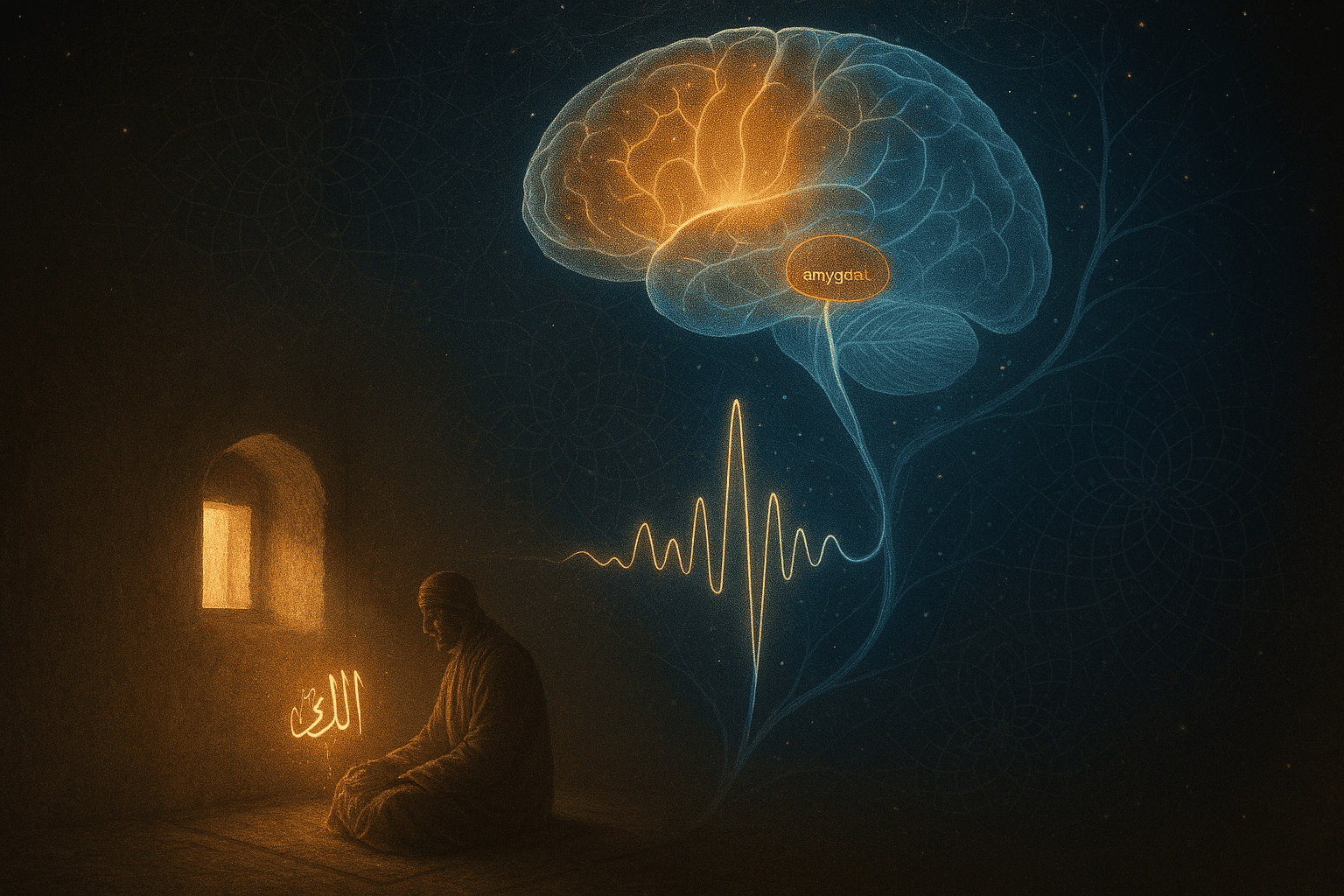
In an era characterized by chronic stress, digital hyper-connectivity, and escalating rates of nervous system dysregulation—manifesting as anxiety, burnout, and autonomic imbalance—ancient contemplative practices are being re-examined through the lens of modern neuroscience. Among these, the Islamic practice of Khalwah (spiritual retreat) presents a profound, structured protocol for disengagement and inner focus that holds significant potential for nervous system recovery. This article explores the principles of Khalwah, its traditional foundations, and its mechanisms of action on the human nervous system. It argues that the deliberate conditions of Khalwah—sensory reduction, prolonged devotion, rhythmic recitation, and intentional solitude—induce a state of deep rest and neuroplastic change that can counter the deleterious effects of chronic stress, promote autonomic nervous system balance, and facilitate top-down regulation of emotional centers. By synthesizing traditional Islamic spirituality with contemporary neurophysiological research, we propose Khalwah not merely as a religious obligation but as a potent biopsychosocial intervention for nervous system restoration.
1. Introduction: The Modern Nervous System and the Need for Retreat
The human nervous system, evolved for acute stressors followed by periods of recovery, is ill-adapted to the persistent, low-grade pressures of contemporary life. The sympathetic nervous system (SNS), responsible for the “fight-or-flight” response, is often chronically engaged, leading to sustained cortisol release, systemic inflammation, and a depletion of physiological and psychological resources (McEwen, 2007). Concurrently, the restorative parasympathetic nervous system (PNS), particularly the ventral vagal complex linked to social engagement and calm, becomes underactive (Porges, 2011). This autonomic imbalance is the substrate for a host of disorders, from anxiety and depression to cardiovascular disease and immune dysfunction.
Recovery requires more than mere cessation of work; it necessitates an active, deliberate shift in state. Enter the concept of Khalwah. Derived from the Arabic root kha-la-wa, meaning to be alone, to retire, to seclude oneself, Khalwah in Islamic mysticism (Sufism) is a prescribed period of withdrawal from worldly affairs for the purpose of spiritual purification, remembrance of God (Dhikr), and attainment of greater awareness (Muḥāsabah). Far from being a passive isolation, it is an active, disciplined, and highly structured engagement with the inner self and the Divine.
This article will detail how the core components of Khalwah act as a comprehensive neuromodulatory regimen, offering a unique path to nervous system recovery that integrates cognitive, emotional, and physiological domains.
2. The Traditional Framework of Khalwah
Traditionally, Khalwah is undertaken under the guidance of a qualified spiritual teacher (Shaykh or Murshid). Its structure is designed to minimize external distraction and maximize internal focus.
- Physical Setting: A simple, secluded cell (often called a khalwah-khāna) or a quiet room, free from external sensory noise.
- Temporal Structure: It can range from 40 days (the classical Arba‘īn or Chilla) to shorter periods of 3, 7, or 10 days. The duration allows for a deepening of practice beyond initial psychological resistance.
- Core Practices:
- Dhikr (Remembrance): The repetitive, rhythmic invocation of divine names or phrases (e.g., La ilaha illa Allah, Allah). This can be silent, whispered, or vocal, and is often synchronized with the breath.
- Fikr (Contemplation): Profound meditation on theological concepts, the attributes of God, or one’s own state.
- Qirā’ah (Quranic Recitation): Slow, reflective reading or chanting of the Quran, with focus on meaning and resonance.
- Salāh (Ritual Prayer): Performing the obligatory and supererogatory prayers with extended concentration (Khushū‘).
- Reduced Stimulation: Minimal speech, fasting, simple diet, and abstinence from entertainment and news.
This framework creates a controlled environment for de-stimulation, directly contrasting the multi-tasking, sensory-saturated modern world.
3. Neurophysiological Mechanisms of Khalwah in Nervous System Recovery
3.1. Sensory Reduction and the Default Mode Network (DMN)
The modern brain is burdened by continuous exogenous stimulation. The secluded, minimalist environment of Khalwah drastically reduces sensory input (auditory, visual, social). This reduction allows for a decrease in outwardly directed attention, mediated by the dorsal attention network. Consequently, there is a natural shift towards the Default Mode Network (DMN), a network active during rest, self-referential thought, and introspection (Raichle, 2015). Chronic stress and anxiety are associated with DMN dysregulation, often involving maladaptive rumination. The structured introspection of Khalwah (Muḥāsabah) may facilitate a reorganization of DMN activity, moving from distressful self-focus to a more integrated, observational self-awareness. This aligns with findings from secular retreats showing that silence and solitude can lead to beneficial changes in DMN connectivity (Berkovich-Ohana et al., 2016).
3.2. Rhythmic Dhikr, Breath, and Autonomic Regulation
The practice of Dhikr is a cornerstone of Khalwah with direct neuromodulatory effects. The rhythmic, repetitive utterance of sacred phrases, often tied to the respiratory cycle, is a form of breath-aware mantra meditation.
- Vagal Stimulation: Slow, controlled breathing, inherent in deliberate Dhikr, is a potent stimulator of the PNS. It increases vagal tone, which is associated with improved heart rate variability (HRV), a key marker of autonomic resilience and adaptability (Lehrer & Gevirtz, 2014). High HRV correlates with better emotional regulation and stress recovery.
- Entrainment and Coherence: The rhythmic nature of Dhikr can entrain biological rhythms—heart rate, respiratory sinus arrhythmia, and even brainwave patterns. This promotes psychophysiological coherence, a state of harmony between cognitive, emotional, and autonomic systems (McCraty & Zayas, 2014). The repetitive auditory feedback, especially in vocal Dhikr, further reinforces this entrainment.
- Neurochemical Shifts: Repetitive devotional practices have been linked to the release of endorphins and endocannabinoids, which promote feelings of peace and well-being. They also modulate the stress response systems, reducing cortisol and adrenergic activity.
3.3. Directed Attention and Top-Down Regulation
Khalwah is a rigorous training in sustained, directed attention (murāqabah or vigilance). Whether focusing on the meaning of Dhikr, the words of the Quran, or the presence of God, the practitioner is continually redirecting focus away from discursive thoughts (wasāwis). This is a direct exercise for the prefrontal cortex (PFC), the brain’s executive center responsible for top-down regulation.
- Strengthening the PFC: Regular, sustained attentional practice strengthens the neural pathways of the PFC, enhancing its ability to inhibit the reactive amygdala (the brain’s fear center). Neuroscientific studies on meditation consistently show increased PFC thickness and connectivity in long-term practitioners (Tang, Hölzel & Posner, 2015).
- Amygdala Downregulation: By cultivating a state of surrender (taslīm) and trust in God (tawakkul), Khalwah can reduce threat perception. The cognitive reframing of challenges as divine decree, combined with attentional control, can lead to decreased amygdala volume and reactivity, similar to findings in mindfulness-based stress reduction (MBSR) programs (Hölzel et al., 2010).
3.4. Sleep Architecture and Neural Restoration
The Khalwah environment, free from artificial light and social obligations, coupled with the fatigue from prolonged devotion, likely promotes more natural and restorative sleep patterns. Deep sleep (slow-wave sleep) is crucial for synaptic homeostasis, memory consolidation, and the clearance of neurotoxic waste products via the glymphatic system (Xie et al., 2013). The reduction of psychological stress further improves sleep quality, creating a positive feedback loop for nervous system repair.
4. The Unique Integrative Elements of Khalwah
While parallels exist with secular meditation retreats, Khalwah incorporates unique dimensions that may amplify its therapeutic impact.
- Sacred Context and Meaning: The entire retreat is framed within a relationship with the Divine. This provides a profound cognitive and emotional framework—stressors, past traumas, and anxieties are not merely observed but are offered up, surrendered, and re-contextualized within a cosmology of divine mercy, purpose, and ultimate justice. This can alleviate existential distress, a significant contributor to modern anxiety.
- Discipline as Safety: The rigorous schedule (awake for night prayers, specific times for Dhikr) is not a burden but a container. It provides predictable structure, reducing uncertainty and the cognitive load of decision-making, which in itself is calming to a stressed nervous system.
- The Role of the Guide: The Shaykh provides a secure attachment figure, offering guidance, interpretation of experiences, and emotional containment. This secure attachment mirrors the neurobiological benefits of therapeutic alliance, activating the PNS’s social engagement system (Porges, 2011).
- Fasting (Sawm): Intermittent fasting, often part of Khalwah, has been shown to promote autophagy (cellular cleanup), reduce inflammation, and enhance BDNF (Brain-Derived Neurotrophic Factor) production, which supports neuroplasticity and neuron health (Mattson, Longo & Harvie, 2017).
5. Potential Challenges and Considerations
Khalwah is a powerful practice and is not without potential neuropsychological challenges. In a state of deep introspection and sensory reduction, individuals may confront suppressed emotions or psychological material. This can lead to temporary periods of heightened anxiety, confusion, or emotional release. This underscores the critical necessity of qualified guidance. A knowledgeable Shaykh can help navigate these states, preventing them from becoming retraumatizing and instead facilitating integration. Individuals with a history of severe psychiatric disorders should undertake Khalwah only with expert spiritual and medical oversight.
Conclusion
The contemporary crisis of nervous system dysregulation demands interventions that operate at multiple levels: physiological, cognitive, emotional, and existential. Khalwah, as a centuries-old spiritual technology, serendipitously embodies a holistic protocol for nervous system recovery. Through its mechanisms of sensory reduction, rhythmic breathwork, attentional training, sacred meaning-making, and structured discipline, it facilitates a shift from sympathetic dominance to parasympathetic predominance, from cortical chatter to mindful presence, and from fragmented selfhood to an integrated sense of being.
Neuroscience now provides a language to describe the inner transformations that contemplatives have reported for millennia. The decreased amygdala reactivity is the neural correlate of “tranquility” (sakīnah). The enhanced PFC-amygdala connectivity is the substrate for “patience” (ṣabr). The coherent, entrained state of the heart and brain during Dhikr is the physiology of “remembrance” (dhikr) and “contentment” (riḍā).
For Muslims, this synthesis validates a core spiritual practice with empirical evidence, encouraging its thoughtful application in modern life. For the broader field of neuromedicine and wellness, it highlights the need to look beyond fragmented, secularized techniques and consider the profound power of integrated, meaning-rich contemplative systems. Khalwah offers a timeless paradigm for retreat—not as an escape from the world, but as a deep dive into the inner resources necessary to engage with the world from a place of balance, resilience, and recovery.
Future research should employ longitudinal designs, measuring biomarkers like cortisol, HRV, inflammatory markers, and neuroimaging (fMRI, EEG) in individuals before and after traditional Khalwah retreats. Such studies would further elucidate the specific neurobiological pathways of this profound practice, bridging the gap between the mosque and the lab, between spirituality and science, in the shared pursuit of human well-being.
SOURCES
Berkovich-Ohana, A., Harel, M., Hahamy, A., Arieli, A., & Malach, R. (2016). Alterations in task-induced activity and resting-state fluctuations in visual and DMN areas revealed in long-term meditators. *NeuroImage, *135*, 125–134.
Hölzel, B. K., Carmody, J., Evans, K. C., Hoge, E. A., Dusek, J. A., Morgan, L., Pitman, R. K., & Lazar, S. W. (2010). Stress reduction correlates with structural changes in the amygdala. *Social Cognitive and Affective Neuroscience, *5*(1), 11–17.
Lehrer, P. M., & Gevirtz, R. (2014). Heart rate variability biofeedback: How and why does it work? *Frontiers in Psychology, *5*, 756.
Mattson, M. P., Longo, V. D., & Harvie, M. (2017). Impact of intermittent fasting on health and disease processes. *Ageing Research Reviews, *39*, 46–58.
McCraty, R., & Zayas, M. A. (2014). Cardiac coherence, self-regulation, autonomic stability, and psychosocial well-being. *Frontiers in Psychology, *5*, 1090.
McEwen, B. S. (2007). Physiology and neurobiology of stress and adaptation: Central role of the brain. *Physiological Reviews, *87*(3), 873–904.
Porges, S. W. (2011). The Polyvagal Theory: Neurophysiological Foundations of Emotions, Attachment, Communication, and Self-regulation. W.W. Norton & Company.
Raichle, M. E. (2015). The brain’s default mode network. *Annual Review of Neuroscience, *38*, 433–447.
Tang, Y.-Y., Hölzel, B. K., & Posner, M. I. (2015). The neuroscience of mindfulness meditation. *Nature Reviews Neuroscience, *16*(4), 213–225.
Xie, L., Kang, H., Xu, Q., Chen, M. J., Liao, Y., Thiyagarajan, M., O’Donnell, J., Christensen, D. J., Nicholson, C., Iliff, J. J., Takano, T., Deane, R., & Nedergaard, M. (2013). Sleep drives metabolite clearance from the adult brain. *Science, *342*(6156), 373–377.
HISTORY
Current Version
Jan 6, 2026
Written By
SUMMIYAH MAHMOOD





Leave a Reply