

Introduction
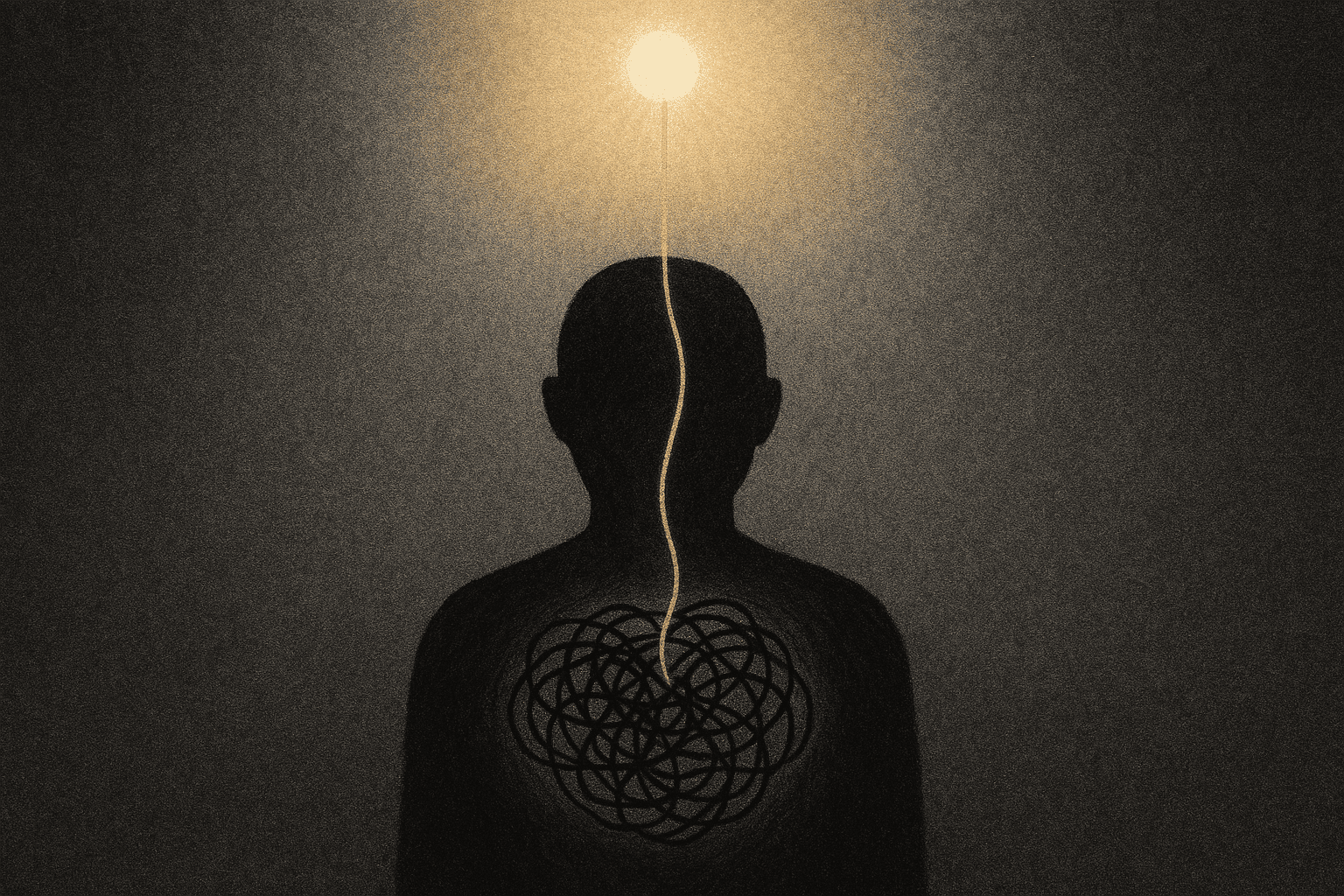
Modern psychology largely frames anxiety as a disorder rooted in deregulated cognition and physiology—an error in threat perception that must be corrected, managed, or eliminated. Within this model, anxiety is typically approached as a malfunction of the nervous system or a distortion of thought processes, addressed through symptom reduction and behavioral control. While these frameworks provide important therapeutic tools and clinical relief, they often remain incomplete when examined through a broader existential and spiritual lens. They explain how anxiety functions, but rarely address what anxiety may signify about the human condition itself.
Islam offers a fundamentally different interpretive framework. Rather than viewing anxiety solely as a defect to be eradicated, Islamic theology reframes it as a signal—a meaningful internal response that points beyond itself. In the Qur’an worldview, emotional states are not random disturbances but part of the human fit rah, designed to guide the heart toward proper orientation. Anxiety, in this sense, becomes a message indicating imbalance: excessive self-reliance, loss of spiritual anchoring, or a heart overburdened with control it was never meant to carry.
At its deepest level, Islam understands anxiety as a call—a call to return to Allah. This return is not framed as punishment or failure, but as mercy and redirection. Through Qur’an anthropology, the human being is recognized as inherently weak and dependent, while Prophetic guidance models how fear, distress, and vulnerability can be transformed into duʿāʾ, shirk, and renewed reliance upon the Divine. Rather than denying or suppressing distress, Islam integrates fear into a redemptive spiritual process that restores humility, meaning, and trust.
In this way, anxiety is no longer merely pathology to be silenced, but a doorway through which the heart is invited back to its true source of security.
1. Anxiety in the Modern World: A Crisis of Orientation
Anxiety has become one of the defining psychological experiences of modern humanity. Despite unprecedented technological advancement, material comfort, and access to information, rates of anxiety disorders continue to rise globally. This paradox reveals a deeper issue: anxiety is not merely about danger—it is about disconnection.
Modern anxiety often emerges from:
- Excessive self-reliance
- Constant future projection
- Loss of existential grounding
- Internalization of total responsibility
In this context, the self becomes both judge and protector, bearing a burden it was never designed to carry.
2. The Limits of the Medical zed Anxiety Model
Contemporary psychology tends to conceptualize anxiety as:
- A chemical imbalance
- A cognitive distortion
- A behavioral conditioning error
While these perspectives are not false, they are partial. They focus on how anxiety operates but often ignore why it grips the heart so powerfully.
What is missing is meaning.
When anxiety is stripped of meaning, the sufferer internalizes shame:
- “Something is wrong with me.”
- “I should not feel this way.”
Islam removes this shame by reframing anxiety as human, expected, and directional.
3. The Islamic Anthropology of the Human Being
To understand how Islam reframes anxiety, one must understand how Islam defines the human being.
3.1 The Human Is Created Weak
The Qur’an states clearly:
“And man was created weak.”
(Qur’an 4:28)
Weakness here does not imply defect. It implies dependence. Anxiety emerges when weakness is denied rather than honored.
3.2 The Alb (Heart) as the Center of Experience
Islam locates emotional and spiritual experience not in the brain alone, but in the alb—the heart.
The heart:
- Turns (taqallub)
- Attaches
- Finds peace or agitation
Anxiety, therefore, is not simply excessive thinking—it is a heart that has lost its anchor.
4. Fear in the Qur’an: Not an Enemy, but a Messenger
The Qur’an does not condemn fear. Instead, it contextualizes it.
Fear becomes destructive only when:
- It disconnects from Allah
- It becomes self-referential
- It leads to despair or paralysis
Otherwise, fear can serve as:
- A reminder of limitation
- A catalyst for humility
- A doorway to remembrance
5. Anxiety as a Signal of Misplaced Reliance
One of the most profound Islamic reframing of anxiety is this:
Anxiety intensifies when reliance shifts away from Allah toward the self.
When the heart believes:
- “I must control outcomes.”
- “I must prevent all harm.”
- “I must guarantee safety.”
Anxiety becomes inevitable.
Islam restores balance through tawakkul—active reliance upon Allah.
6. Tawakkul: The Antidote to Existential Anxiety
Tawakkul is often misunderstood as passivity. In reality, it is engaged surrender.
True tawakkul involves:
- Taking means responsibly
- Releasing ultimate control
- Trusting divine wisdom beyond perception
When tawakkul weakens, anxiety fills the vacuum.
7. Qur’an Reframing: Anxiety as a Call to Return
One of the most overlooked spiritual insights is that anxiety often intensifies when distance from Allah increases, not as punishment—but as mercy.
“And whoever turns away from my remembrance—indeed, he will have a constricted life.”
(Qur’an 20:124)
Classical scholars explain “constricted life” as:
- Inner tightness
- Emotional suffocation
- Persistent unease
Anxiety, then, becomes a signal to return, not evidence of failure.
8. The Prophet ﷺ and Human Vulnerability
The Prophet ﷺ experienced:
- Fear
- Grief
- Distress
- Physical trembling
Yet he was never emotionally detached.
This teaches a crucial truth:
Spiritual excellence does not mean emotional numbness.
Anxiety is not a sign of weak man; it is a sign of humanity seeking anchoring.
9. Duʿāʾ: Turning Anxiety into Dialogue
When anxiety turns inward, it loops. When it turns upward, it transforms.
Duʿāʾ converts anxiety from:
- A closed system → an open relationship
- Internal chaos → external surrender
The Prophet ﷺ taught supplications specifically for distress, showing that anxiety is meant to be spoken, not suppressed.
10. From Pathology to Purpose
Islam does not romanticize anxiety, but it redeems it.
Anxiety becomes:
- A reminder of finitude
- A call to remembrance
- A realignment of priorities
- A return to dependence
Rather than asking, “How do I get rid of this feeling?”, Islam invites the question:
“What is this feeling calling me back to?”
11. Fear (Khawf) vs. Anxiety (Alas): A Qur’an Distinction
Islam draws a subtle but essential distinction between chaw (fear) and what modern psychology labels anxiety.
11.1 Chaw: Purposeful Fear
Chaw in the Qur’an is:
- Directional
- Meaningful
- Regulating
Fear of Allah does not paralyze—it stabilizes. It creates moral clarity and spiritual grounding.
“So fear me alone.”
(Qur’an 2:40)
This fear organizes the heart.
11.2 Anxiety: Fear without Direction
Anxiety emerges when fear becomes:
- Objectless
- Excessive
- Self-referential
Instead of pointing toward Allah, it circles the self. Islam does not condemn this state—it explains it.
Anxiety is fear that has lost its compass.
12. The Heart under Pressure: How Distance from Allah Manifests Emotionally
Islamic scholars consistently describe spiritual distance not as rebellion alone, but as inner constriction.
12.1 The Qur’an Language of Tightness
The Qur’an describes spiritual disorientation as:
- Narrowing of the chest
- Heaviness of the heart
- Suffocation of the inner self
“Whomever Allah allows to stray, He makes his chest tight and constricted…”
(Qur’an 6:125)
Classical tafsīr explains this constriction as persistent unease and anxiety, not merely disbelief.
12.2 Anxiety as Mercy, Not Punishment
This constriction is not revenge—it is guidance through discomfort. When comfort would allow heedlessness to continue, discomfort becomes the teacher.
Anxiety, in this sense, is:
- An internal alarm
- A corrective signal
- A call to re-anchor
13. Waswasa: The Spiritual-Cognitive Loop
Islam uniquely identifies waswasa—repetitive, intrusive whisperings—as a spiritual-psychological phenomenon.
13.1 Characteristics of Waswasa
Waswasa involves:
- Repetitive doubt
- Catastrophic imagination
- Persistent uncertainty
- Self-attacking thoughts
These closely resemble modern anxiety loops.
13.2 Why Waswasa Targets the Anxious Heart
Waswasa intensifies when:
- The heart is exhausted
- The self is overburdened
- Reliance is internalized
The Qur’an does not suggest arguing with waswasa, but seeking refuge.
“Say: I seek refuge in the Lord of mankind…”
(Qur’an 114:1)
This is a profound therapeutic insight: some thoughts are not meant to be debated—they are meant to be redirected.
14. Islam Rejects Self-Sufficiency as a Psychological Ideal
Modern culture celebrates self-mastery, independence, and emotional self-containment. Islam challenges this narrative at its core.
14.1 The Myth of the Self-Sufficient Human
Anxiety thrives where the self believes:
- “I must be strong at all times.”
- “I cannot collapse.”
- “I must handle this alone.”
Islam dismantles this illusion:
“O mankind, you are those in need of Allah.”
(Qur’an 35:15)
Neediness is not shameful—it is ontological truth.
14.2 Emotional Collapse as a Spiritual Doorway
In Islam, moments of emotional breaking are often moments of greatest nearness. Tears, fear, and vulnerability are not barriers to Allah—they are bridges.
15. Duʿāʾ as the Language of Anxiety
When anxiety is reframed as a call, duʿāʾ becomes its natural response.
15.1 Why Anxiety Demands Expression
Anxiety intensifies when silenced. Duʿāʾ allows:
- Expression without judgment
- Vulnerability without shame
- Need without apology
Allah invites anxious speech:
“Call upon me; I will respond to you.”
(Qur’an 40:60)
15.2 Prophetic Duʿāʾ for Distress
The Prophet ﷺ taught specific supplications for anxiety, including:
“O Allah, I seek refuge in you from anxiety and sorrow…”
This confirms that anxiety is not denied—it is addressed relationally.
16. Saber Revisited: Emotional Endurance, Not Suppression
Saber is frequently misunderstood as emotional silence. In reality, saber is:
- Staying oriented under distress
- Maintaining trust during uncertainty
- Continuing movement despite fear
Anxiety does not negate saber; how one responds to anxiety defines saber.
17. Grief, Trauma, and the Legitimacy of Pain
Islam does not flatten emotional experience into “just trust Allah.”
17.1 The Prophet ﷺ and Grief
The Prophet ﷺ wept, trembled, and expressed sorrow. Yet he never framed these emotions as spiritual failure.
This teaches:
Pain is not the opposite of faith. Despair is.
17.2 Trauma and Spiritual Safety
For trauma survivors, anxiety may not feel like a gentle call—it may feel overwhelming. Islam accommodates this by emphasizing:
- Divine gentleness
- Gradual healing
- Mercy before obligation
18. Dhaka as the Answer to the Call
If anxiety is the call, shirk is the response.
“Indeed, in the remembrance of Allah do hearts find rest.”
(Qur’an 13:28)
Dhaka does not eliminate hardship—it restores inner safety within hardship.
19. from Control to Trust: The Core Transformation
At its root, anxiety asks:
- “What if I cannot handle this?”
Islam answers:
“Allah is sufficient for you.”
This shift—from self-containment to divine reliance—is the heart of healing.
20. Anxiety as a Spiritual Teacher
When approached correctly, anxiety teaches:
- Humility
- Dependency
- Presence
- Return
What feels like an enemy becomes a guide.
21. Anxiety Is Not Divine Punishment
One of the most damaging beliefs held by anxious believers is the idea that anxiety itself is a punishment from Allah. This assumption intensifies guilt, shame, and despair—deepening distress rather than resolving it.
Islamic theology clearly rejects this framing.
21.1 Tests vs. Punishment
The Qur’an distinguishes between:
- Ibtilāʾ (tests meant to elevate)
- ʿAdhāb (punishment meant to restrain injustice)
Anxiety, when it draws the heart closer to Allah, functions as ibtilāʾ, not punishment.
“Allah does not burden a soul beyond what it can bear.”
(Qur’an 2:286)
This verse affirms that distress is proportionate, purposeful, and bounded by mercy.
21.2 The Mercy Hidden Within Discomfort
Classical scholars explain that Allah sometimes removes emotional comfort in order to restore spiritual clarity. When ease leads to heedlessness, discomfort becomes guidance.
Thus, anxiety is not abandonment—it is intervention.
22. A Practical Reframing Model: From Anxiety to Return
To fully internalize the Islamic reframing of anxiety, it is helpful to follow a four-stage interpretive model.
- Stage 1: Recognition: “This feeling is anxiety. It is uncomfortable, but meaningful.”
- Stage 2: Interpretation: “This anxiety may be signaling misplaced reliance or spiritual fatigue.”
- Stage 3: Turning: “I respond by turning to Allah through duʿāʾ, shirk, and trust.”
- Stage 4: Integration: “I allow this experience to deepen humility, presence, and reliance.”
This model transforms anxiety from a threat into a pathway.
23. Preventing Spiritual Bypass
Islam warns against spiritual bypass—using religious language to avoid emotional work.
23.1 What Spiritual Bypass Looks Like
- Forcing positivity
- Silencing grief with clichés
- Using “just have tawakkul” to avoid processing pain
True tawakkul includes honesty with Allah, not denial.
23.2 Emotional Truthfulness as Worship
Expressing fear, confusion, and weakness before Allah is an act of worship. The Qur’an repeatedly records the supplications of prophets in moments of fear and uncertainty.
This teaches that emotional authenticity invites divine nearness.
Conclusion
Anxiety, in the Islamic worldview, is neither an enemy to be destroyed nor a flaw to be ashamed of. It is a signal, a message, and often a mercy disguised as discomfort. Where modern frameworks often ask how anxiety can be eliminated, Islam asks how anxiety can be oriented.
When fear turns inward, it suffocates the heart. When it turns toward Allah, it becomes duʿāʾ. The anxious heart is not a broken heart—it is a heart searching for anchoring. Islam does not demand emotional invincibility; it invites relational dependence.
Through Qur’an guidance, Prophetic example, and centuries of scholarly reflection, Islam reframes anxiety as a call to return—not necessarily because one has strayed in sin, but because one has drifted into excessive self-reliance. In this light, anxiety is not proof of weak faith, but evidence of human limitation seeking divine support.
The believer is not asked to silence fear, but to redirect it. Not to suppress distress, but to carry it into remembrance. Not to become fearless, but to become directional. And in that direction—toward Allah—the heart discovers that what it feared was never abandonment, but invitation.
“So remember me; I will remember you.”
(Qur’an 2:152)
This is the final answer to anxiety: remembrance over rumination, reliance over control, and return over resistance.
SOURCES
Al-Ghazālī (1105) – Iḥyāʾ Culm al-Den – Spiritual psychology of fear and the heart
Bin al-Qayyim (1350) – Mandarin al-Sālikīn – Emotional states and reliance on Allah
Bin Taymiyyah (1328) – Dhaka, distress, and divine sufficiency
Al-Qurṭubī (1273) – Tafsīr on constriction of the chest
Faker al-Den al-Raze (1210) – Tafsīr on tranquility and fear
Prophetic Sunni (Bukhara & Muslim) – Supplications for anxiety and grief
DSM-5-TR (2022) – Clinical classification of anxiety disorders
Beck (1976) – Cognitive theory of anxiety
Limoux (1996) – Neurobiology of fear
Purges (2011) – Polyvagal theory and safety regulation
Bessel van deer Koll (2014) – Trauma and embodied fear
Hayes et al. (2012) – Acceptance-based anxiety treatment
Kabat-Zinn (1990) – Mindfulness and stress
Bowl by (1988) – Attachment theory
Siegel (2010) – Interpersonal neurobiology
Koenig (2012) – Religion and mental health
Vie ten et al. (2013) – Spirituality in clinical practice
Bari (1979) – The Dilemma of Muslim Psychologists
Bari (2013) – Contemplative practices in Islam
Hague & Mohamed (2009) – Foundations of Islamic psychology
Nasr (2002) – Sacred remembrance and modern dislocation
Rothschild (2000) – Trauma and nervous system regulation
Lineman (1993) – Emotional regulation models
Ayden (2017) – Dhaka and emotional well-being
Husain et al. (2018) – Faith-based coping and anxiety
Yusuf al-Qaradawi (1998) – Balance between reliance and effort
Shapiro (2001) – Mechanisms of mindfulness
HISTORY
Current Version
Dec 29, 2025
Written By
ASIFA




Leave a Reply