

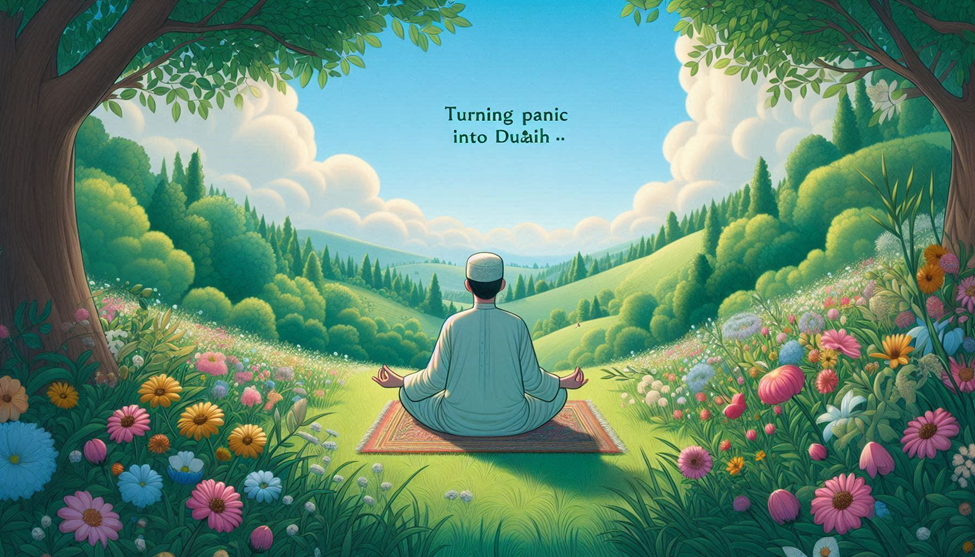
Introduction: Panic as a Cry for Orientation
Panic is among the most intense and disorienting human experiences. It often appears suddenly, overwhelming the body with a surge of fear, accelerating the heartbeat, constricting the breath, and convincing the mind that safety has vanished. The body reacts as though under immediate threat, flooding with adrenaline, while thoughts spiral into catastrophic anticipation. Contemporary psychology frequently interprets panic through a clinical lens, framing it as a malfunction of the nervous system—a misfiring of threat detection that requires control, correction, or suppression. Cognitive-behavioral interventions, exposure therapy, and breath regulation are often recommended to “normalize” the response and restore equilibrium. While these approaches provide valuable tools for managing acute panic, they often fail to address the existential and spiritual dimensions of fear, leaving a sense of inner fragmentation unresolved.
The Sunni of the Prophet ﷺ, however, presents a radically different and holistic framing. Panic is neither dismissed nor pathologies; it is acknowledged, honored as a human experience, and redirected toward meaningful engagement. In Islamic teaching, moments of intense fear are signals—a call to turn the heart toward Allah through du‘āʾ. Supplication transforms what is otherwise destabilizing into an opportunity for relational reliance, ethical reflection, and spiritual grounding. Panic is not interpreted as evidence of weak man or divine displeasure; rather, it becomes a catalyst for presence, trust, and self-regulation.
This approach is psychologically sophisticated. By externalizing fear through du‘āʾ, the believer interrupts ruminative cycles, regulates breath, and stabilizes the nervous system, all while cultivating spiritual awareness. The act of turning inward toward Allah transforms vulnerability into worship. In this way, the Islamic tradition reframes panic: not as an enemy to be eliminated, but as a gateway for connection, growth, and relational trust. It exemplifies a model in which emotional, cognitive, and spiritual dimensions are integrated, offering a deeply humane and spiritually grounded response to human fragility.
1. Understanding Panic: A Psycho physiological Reality
Panic is a state of acute autonomic activation involving:
- Sudden sympathetic nervous system dominance
- Rapid heart rate and shallow breathing
- Hyper vigilance and catastrophic thinking
- A sense of imminent danger or loss of control
Importantly, panic is not voluntary. It reflects the body’s attempt to protect itself under perceived threat. The Qur’an acknowledges this vulnerability:
“Man was created weak.”
(Qur’an 4:28)
Islam does not shame the frightened nervous system. Instead, it provides direction for moments when fear overtakes reason.
2. The Prophetic Model: Fear Redirected, Not Denied
The Prophet ﷺ experienced fear, sorrow, and distress—yet his response was never avoidance. When faced with danger, uncertainty, or overwhelming situations, his immediate reflex was turning to Allah.
Bin abbes (raḍiyallāhu ʿanhumā) reported:
“When the Prophet ﷺ was distressed, he would say:
All aloha ill Allah al-ʿAẓīm al-Alum…”
This establishes a Sunni principle: panic is a cue for du‘āʾ.
3. Du‘āʾ as an Instinctive Regulation Response
From a psychological lens, effective panic regulation requires:
- Externalizing fear
- Slowing physiological arousal
- Restoring a sense of safety and meaning
Du‘āʾ fulfills all three simultaneously.
When fear is spoken to Allah:
- The burden is no longer contained within the self
- Breath naturally slows through verbalization
- Meaning replaces chaos
The Prophet ﷺ taught du‘āʾ not as formal poetry, but as emergency language for the overwhelmed soul.
4. Panic vs. Tawakkul: A False Dichotomy
A common misconception is that panic contradicts reliance on Allah. In reality, tawakkul begins where panic ends—but panic often precedes tawakkul.
True reliance is not emotional numbness. It is the act of turning with fear rather than away from Allah.
The Companions experienced fear in battle, yet Allah praised them for responding with remembrance, not denial.
5. The Language of Du‘āʾ During Panic
Prophetic do’s during distress share key features:
- Short, repetitive phrases
- Divine attributes emphasizing mercy, power, and patience
- Language that affirms safety through Allah’s control
Examples include:
- Ḥasbiyallāhu all aloha ill Hula
- Allāhumma raḥmataka raj
- I Day, by Qayyūm
These phrases function as verbal anchors, stabilizing cognition during emotional flooding.
6. Turning Panic into Du‘āʾ: A Step-by-Step Sunni Pattern
- Step 1: Acknowledge Fear without Shame: Islam never demands emotional denial. Panic is named, not suppressed.
- Step 2: Immediate Verbal Turning: Even before calm returns, the tongue turns to Allah.
- Step 3: Attribute Power to Allah: Fear shrinks when divine control is named.
- Step 4: Surrender Outcome: Du‘āʾ ends with release, not control.
7. Du‘āʾ as Attachment Repair
From attachment psychology, panic reflects threatened safety. Du‘āʾ restores:
- A secure attachment figure (Allah)
- A sense of being seen and heard
- Emotional co-regulation
Allah describes Himself as:
“Closer to him than his jugular vein.”
(Qur’an 50:16)
8. Why Panic Worsens Without Du‘āʾ
When panic remains internal:
- Thoughts escalate
- Fear feeds on itself
- The nervous system stays activated
Du‘āʾ interrupts this loop by externalizing fear into relationship.
9. The Prophet ﷺ and Night-Time Anxiety
Many do’s were specifically taught for moments of night-time distress, recognizing that fear and panic often intensify during quiet hours. Night is a period when the mind becomes more reflective, fatigue accumulates, and feelings of isolation can magnify anxiety. Islamic tradition demonstrates a trauma-aware sensitivity, offering supplications that address vulnerability windows rather than treating distress as moral failure. These do have provided a structured outlet for expressing fear, which both comforts the heart and reinforces trust in Allah. The Prophet ﷺ encouraged turning to Allah in these moments, teaching believers that even the darkness of night can become a time of spiritual proximity. By verbalizing need, the believer transforms a psychologically vulnerable moment into one of connection and presence. Night-time supplications stabilize attention, provide emotional rhythm, and remind the believer that fear does not have the final word—the relationship with the Divine does.
10. Du‘āʾ vs. Rumination
Rumination traps fear in repetitive, internal loops, often magnifying anxiety and immobilizing decision-making. In contrast, du‘āʾ channels fear outward, redirecting the emotional energy toward Allah. This redirection is not avoidance or denial; it is a purposeful engagement with the reality of fear, acknowledging its presence while seeking guidance, relief, or patience. By externalizing the emotional load, the believer experiences both psychological and spiritual release. Du‘āʾ replaces obsessive thinking with intentional speech and attention, giving structure to what would otherwise feel chaotic. Moreover, this process reinforces the cognitive principle of cognitive reframing, where perception of threat is actively transformed. In practical terms, instead of fear looping endlessly in the mind, du‘āʾ converts anxiety into a dialogue with the Most Merciful, fostering clarity, emotional regulation, and renewed trust in divine wisdom.
11. Panic Attacks and Spiritual Misinterpretation
Islamic teachings carefully avoid interpreting panic as a sign of weak man, divine displeasure, or moral failure. Panic is a physiological and emotional response to stress, not a spiritual deficiency. Viewing it as an invitation rather than condemnation transforms perception: the moment of panic becomes an opportunity to turn toward Allah, to seek refuge, and to practice presence. This perspective honors human vulnerability without layering guilt onto fear. It also aligns with modern trauma-informed principles, which recognize that distress signals are natural and informative rather than shameful. In this framework, panic can catalyze spiritual growth, prompting self-reflection, connection to the Divine, and ethical recalibration. By reframing panic as a doorway rather than a deficiency, Islam provides both compassion and agency, allowing believers to respond constructively to overwhelming emotional episodes without fear of judgment.
12. Repetition: Why Du‘āʾ is Repeated During Fear
Repetition of du‘āʾ serves both psychological and spiritual functions. Physiologically, repeating a familiar supplication stabilizes the nervous system, regulating heart rate and inducing calm through rhythmic vocalization. Spiritually, repetition reinforces trust in Allah, embedding reliance into the believer’s habitual consciousness. The Prophet ﷺ often used short, repeated do’s during distress, providing a template for accessible, sustainable practice. Repetition also functions as a meditative anchor, drawing attention away from spiraling fear and toward mindful presence. Neuroscientific research supports this approach, demonstrating that repeated verbalization of positive or meaningful phrases can reduce amygdale hyperactivity, which underlies panic and anxiety. In this way, repetitive du‘āʾ creates a dual effect: calming the body while cultivating the soul, showing that spiritual practice and emotional regulation are not separate domains but mutually reinforcing.
13. Du‘āʾ and Breath Regulation
The act of speaking du‘āʾ naturally synchronizes with breath, producing an unintentional yet powerful calming effect. Controlled exhalation during supplication reduces sympathetic nervous system activity, lowering heart rate and mitigating the physical symptoms of panic. In psychological terms, breath regulation is among the most effective interventions for acute anxiety, and du‘āʾ achieves this without requiring explicit instruction. Moreover, the vocal and cognitive focus inherent in prayer redirects attention from internal threat loops to intentional communication with Allah. Over time, this practice strengthens self-regulation and enhances resilience to stress. The alignment of body, breath, and spirit illustrates Islam’s holistic approach to fear management: emotional, physiological, and spiritual dimensions work together. By integrating du‘āʾ with natural breathing rhythms, panic becomes not just tolerable but transformable into a structured spiritual and somatic experience.
14. Turning Fear Into Worship
When panic is intentionally transformed into du‘āʾ, fear itself becomes a form of ʿibādah (worship). The energy of panic is not wasted or ignored; it is redirected toward conscious engagement with the Divine. This approach reframes emotional states, allowing anxiety to serve spiritual rather than destructive purposes. The psychological principle mirrors cognitive-behavioral strategies: emotions are acknowledged and processed, not suppressed, while behavioral or attentional shifts reframe the experience. Spiritually, the act of turning fear into supplication demonstrates humility, reliance, and active engagement in ʿubūdiyyah (servitude). In effect, panic is no longer a purely negative experience but a conduit for growth, presence, and ethical alignment. The believer learns that moments of intense emotion can be sacred, serving both inner regulation and relational proximity to Allah, thus integrating mental health principles seamlessly into spiritual practice.
Conclusion
Turning panic into du‘āʾ does not mean denying the reality of fear or pretending that one is unaffected by life’s pressures. On the contrary, Islam acknowledges the full spectrum of human emotion, including vulnerability, anxiety, and despair. The Sunni guides the believer not to erase fear but to redirect it—making it purposeful rather than destructive. When fear has a destination, when it is consciously turned toward Allah, it loses its capacity to paralyze and overwhelm. The very act of raising one’s hands in supplication, of calling out for help with sincerity, channels the energy of panic into something constructive. In moments of distress, the heart that might otherwise collapse under pressure instead articulates a cry that is both intimate and transformative. What would isolate a person in shame or helplessness instead becomes a bridge—a connection with the Divine that affirms presence, attention, and care. What might otherwise spiral into despair becomes an instrument of nearness, a means of drawing closer to the One who is merciful, compassionate, and all-aware. Du‘āʾ, therefore, functions as a spiritual technology of resilience: it converts emotional chaos into focus, vulnerability into humility, and helplessness into ethical and existential agency. In turning to Allah, the believer is reminded that panic is not the end, but a moment pregnant with the potential for trust and surrender. Even when the body trembles or the mind races, the soul finds steadiness in the act of calling out to its Creator. In this sense, du‘āʾ is among the most compassionate responses Islam offers to human fragility, providing a framework through which overwhelming moments are not wasted or feared, but redeemed. They become opportunities for presence, worship, and the cultivation of a heart that, even amidst anxiety, recognizes the guiding hand of Divine care.
SOURCES
The Qur’an (7th century) — the foundational scripture of Islam; provides guidance on duʿāʾ, trust in Allah, and managing fear.
Shih al‑Bukhari (9th century) — Collection of authentic Prophetic traditions on duʿāʾ, reliance on Allah, and emotional resilience.
Shih Muslim (9th century) — Companion collection emphasizing supplication and seeking divine support in fear and hardship.
Ray as‑Ṣāliḥīn by An‑Nawawi (13th century) — Classical compilation focusing on personal conduct, patience, trust, and duʿāʾ.
Iḥyāʾ Culm adding by Al‑Ghazālī (11th century) — Explores Islamic spirituality and the inner life, including duʿāʾ as a transformative practice.
Laguna lit alibi Ṭarīq al‑Ḥaqq by Abdu al-Qadir Glint (12th century) — Discusses worship, ethics, and turning to Allah in times of fear and need.
Hajji Allah al‑Bāligha by Shah Waliullah Declaw (18th century) — Integrates theology with psychological and existential insights relevant to fear and trust.
Al‑Tawḥīd: Its Implications for Thought and Life by Ismāʿīl al‑Faruqī (1982) — Explores Tawḥīd as the theological basis for reliance and trust in Allah.
Alaska’ we al‑Ṣifat by Al‑Bayhaqi (11th century) — Classical exposition of God’s attributes, foundational for understanding duʿāʾ and fear.
Al‑ʿAqīda al‑Tahāwiyya by Abu Afar al‑Tahawi (10th century) — Succinct Sunni creed explaining basic beliefs, trust, and the believer’s relationship with Allah.
Bin al‑Qayyim on Tawḥīd, the Ways and Means, Fear and Reliance (2020) — Modern article outlining Ibn al‑Qayyim’s perspective on fear and reliance on God.
Mental Health and Spiritual Well‑Being in the Qurān (2024) — Academic research linking Islamic practices to emotional resilience and well-being.
Between FOMO and Qana’ah (2025) — Applies Ibn Qayyim’s spiritual framework to contemporary psychological challenges, including anxiety.
Mediating Role of Tawakkul between Religious Orientation and Anxiety (2022) — Empirical study on the psychological effects of tawakkul on anxiety.
The Concept of Tawakkul in the Qur’an and Habit (2025) — Research on tawakkul as a coping mechanism in contemporary life.
Spirituality and Psychological Wellbeing: Insights from the Qur’an and Sunni (2025) — Interdisciplinary study linking Islamic spiritual practices with psychological health.
Fear in the Qurʾān by Mohammad Yusuf Alder (2015) — Examines fear in the Qur’an, contrasting fear of God with panic and despair.
Tawakkul: Exemplary Deeds of the Mother and Sister of Prophet Mūsā (2024) — Examines tawakkul under fear and uncertainty through Qur’an narratives.
Maʿārif al‑Qurʾān (Commentaries) — Scholarly commentaries on Qur’an verses about supplication, fear, and trust.
HISTORY
Current Version
Dec 27, 2025
Written By
ASIFA




Leave a Reply